
Use this indicator directly on TradingView — the world's most popular charting platform.
What does the Wyckoff Re-Accumulation & Re-Distribution indicator do?
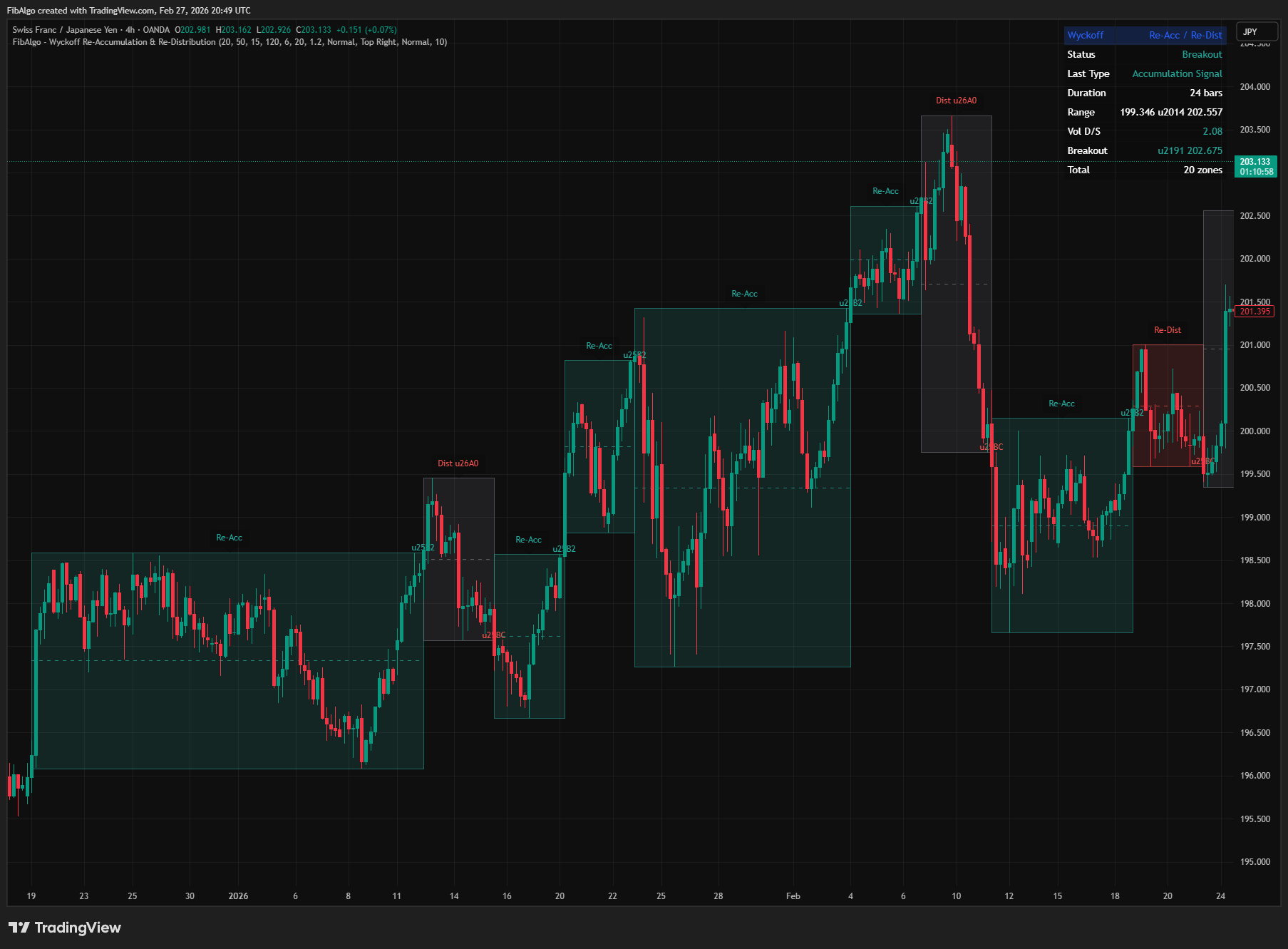
FibAlgo - Wyckoff Re-Accumulation & Re-Distribution automatically detects consolidation pauses within established trends and classifies them as continuation patterns (Re-Accumulation or Re-Distribution) or potential reversal warnings (Distribution or Accumulation). The indicator uses EMA-based trend detection, volatility-relative price-range analysis for consolidation identification, and demand/supply volume profiling that drives the tentative (forming) and timeout classification and is reported with every breakout as supporting evidence for telling institutions pausing to add positions (stepping stones) apart from genuine trend reversals. Wyckoff taught that trends rarely move in straight lines — markup phases produce Re-Accumulation trading ranges ("stepping stones") where the Composite Man acquires additional shares, while markdown phases produce Re-Distribution ranges where positions are extended. The volume behavior within these pauses is the key differentiator: in Re-Accumulation, volume diminishes on dips and increases on rallies; in Re-Distribution, the opposite occurs.
Key Concepts
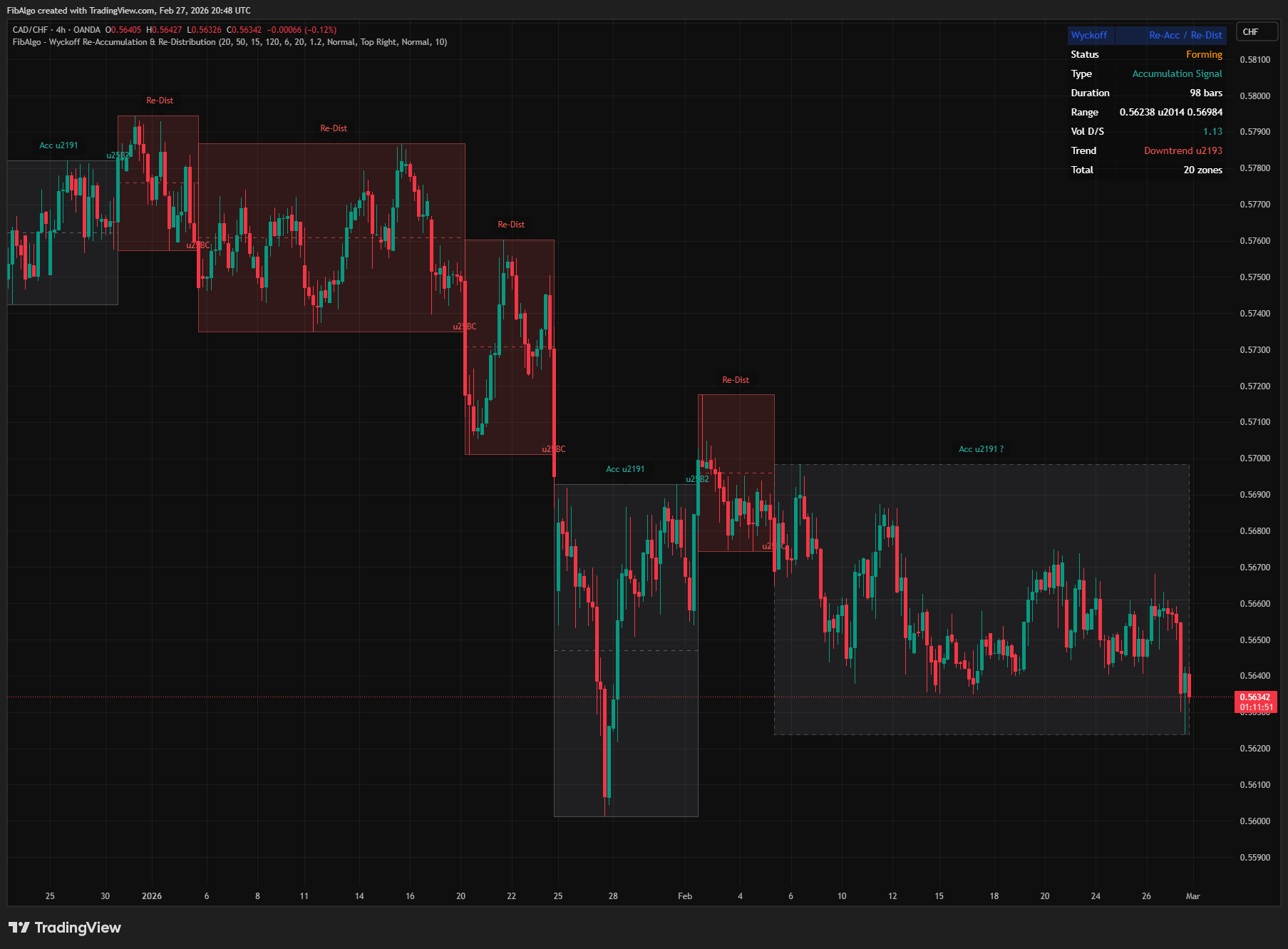
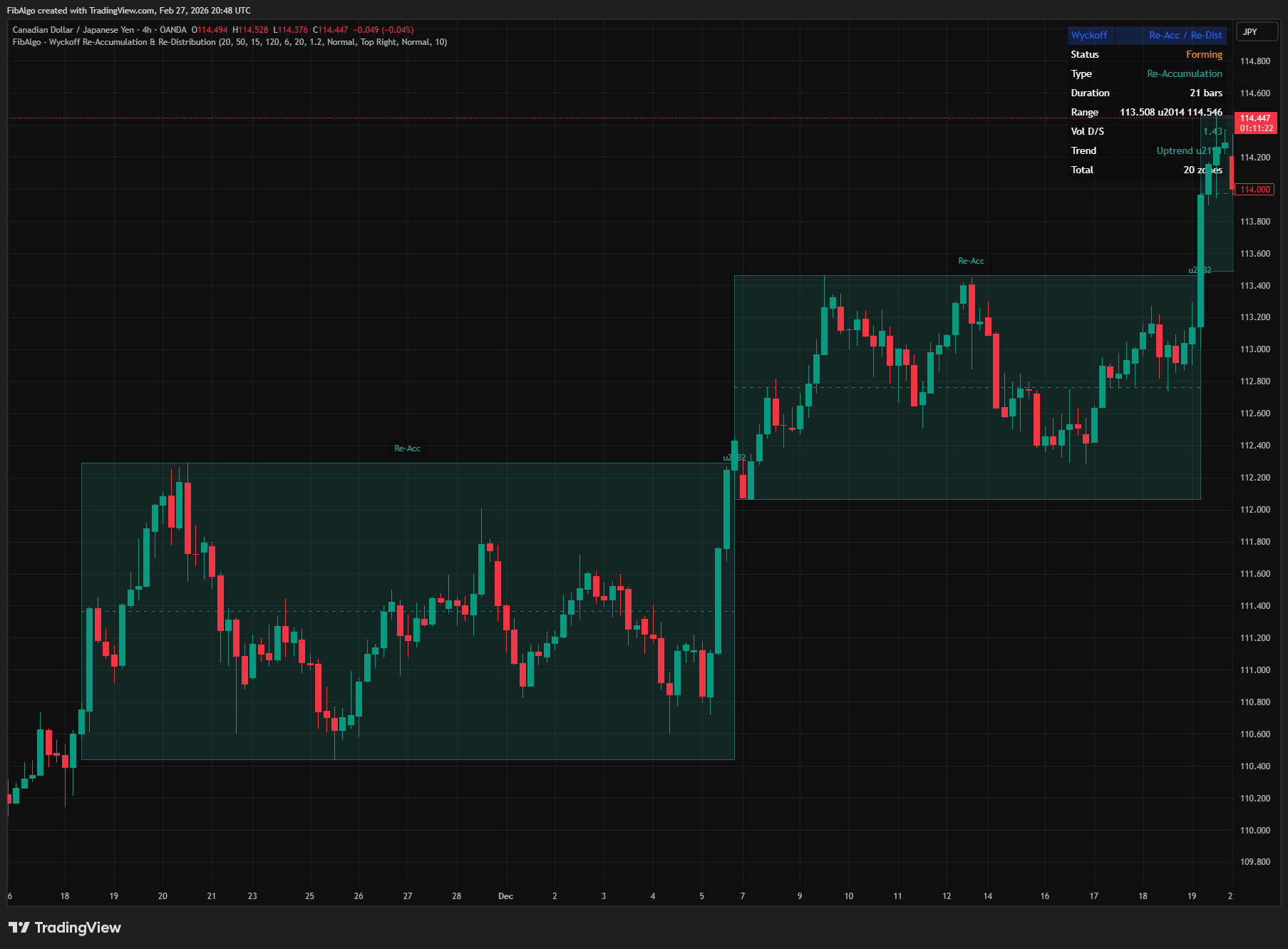
- Re-Accumulation (Stepping Stone) — A consolidation trading range that forms during a larger uptrend. The Composite Man takes profits and/or acquires additional shares before the next leg up. Volume diminishes on dips (supply absorbed) and increases on rallies (demand present). These pauses are "stepping stones" on the way to higher targets. Phase A may resemble distribution, but volume behavior reveals the true nature.
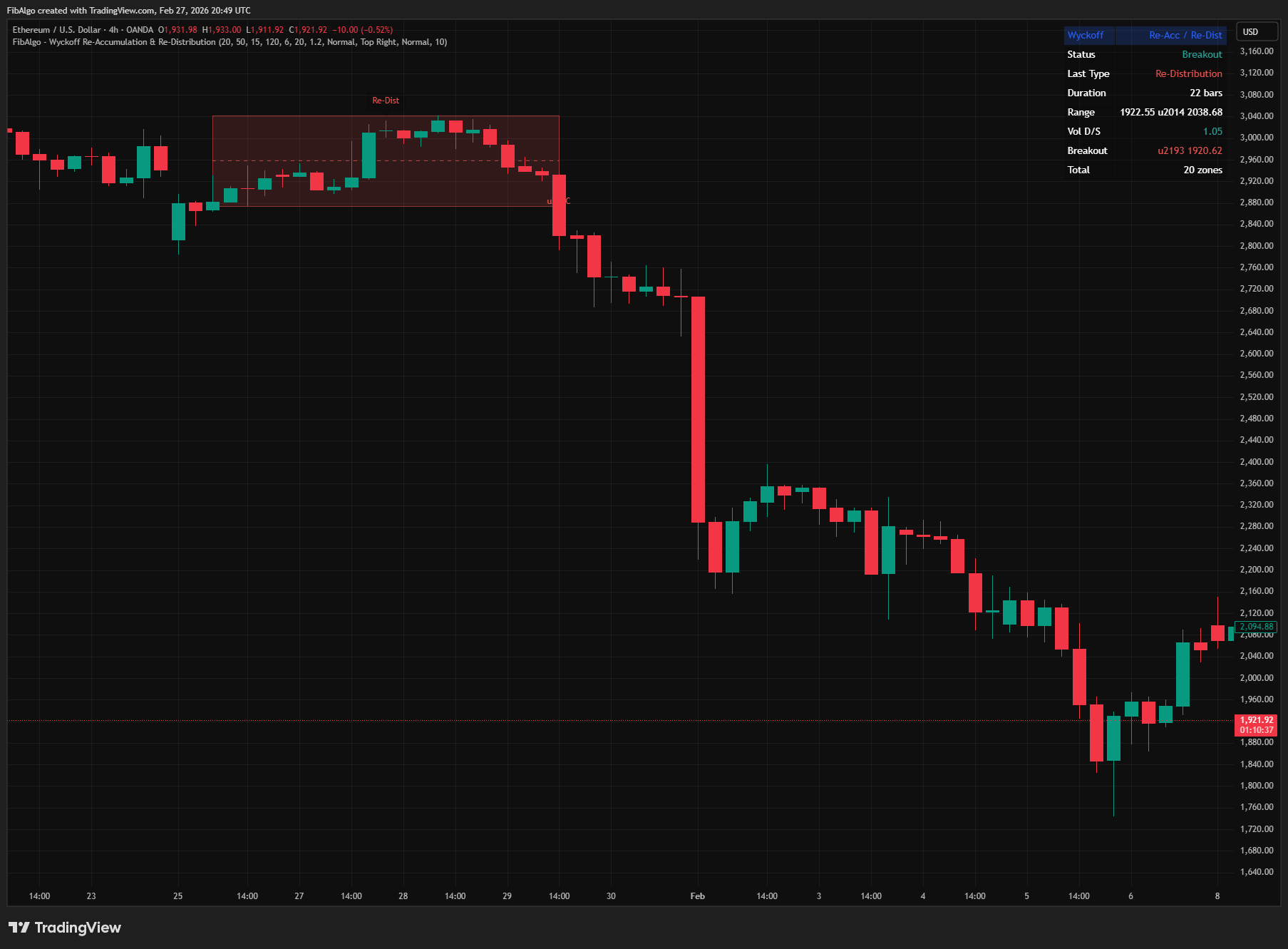
- Re-Distribution (Stepping Stone) — A consolidation trading range that forms during a larger downtrend. The Composite Man may add to short positions during the pause. Volume increases on declines (supply dominant) and diminishes on rallies (demand exhausted). These are "stepping stones" on the way to lower targets. Phase A may resemble accumulation, but feeble rallies and persistent supply reveal the continuation pattern.
- Demand/Supply Volume Ratio — The indicator classifies each bar within a consolidation zone as a demand bar (close > open, volume attributed to buying pressure) or supply bar (close < open, volume attributed to selling pressure). The ratio of total demand volume to supply volume reveals whether institutions are accumulating (ratio > 1.0) or distributing (ratio < 1.0) within the pause.
- Trend Context — The prior trend direction before consolidation is critical. Two EMAs establish the context: fast above slow with the slow EMA rising = uptrend, fast below slow with the slow EMA falling = downtrend. A consolidation within an uptrend that breaks out upward is classified as Re-Accumulation, and demand-dominant volume inside the range confirms it. A consolidation within a downtrend that breaks out downward is classified as Re-Distribution, and supply-dominant volume inside the range confirms it.
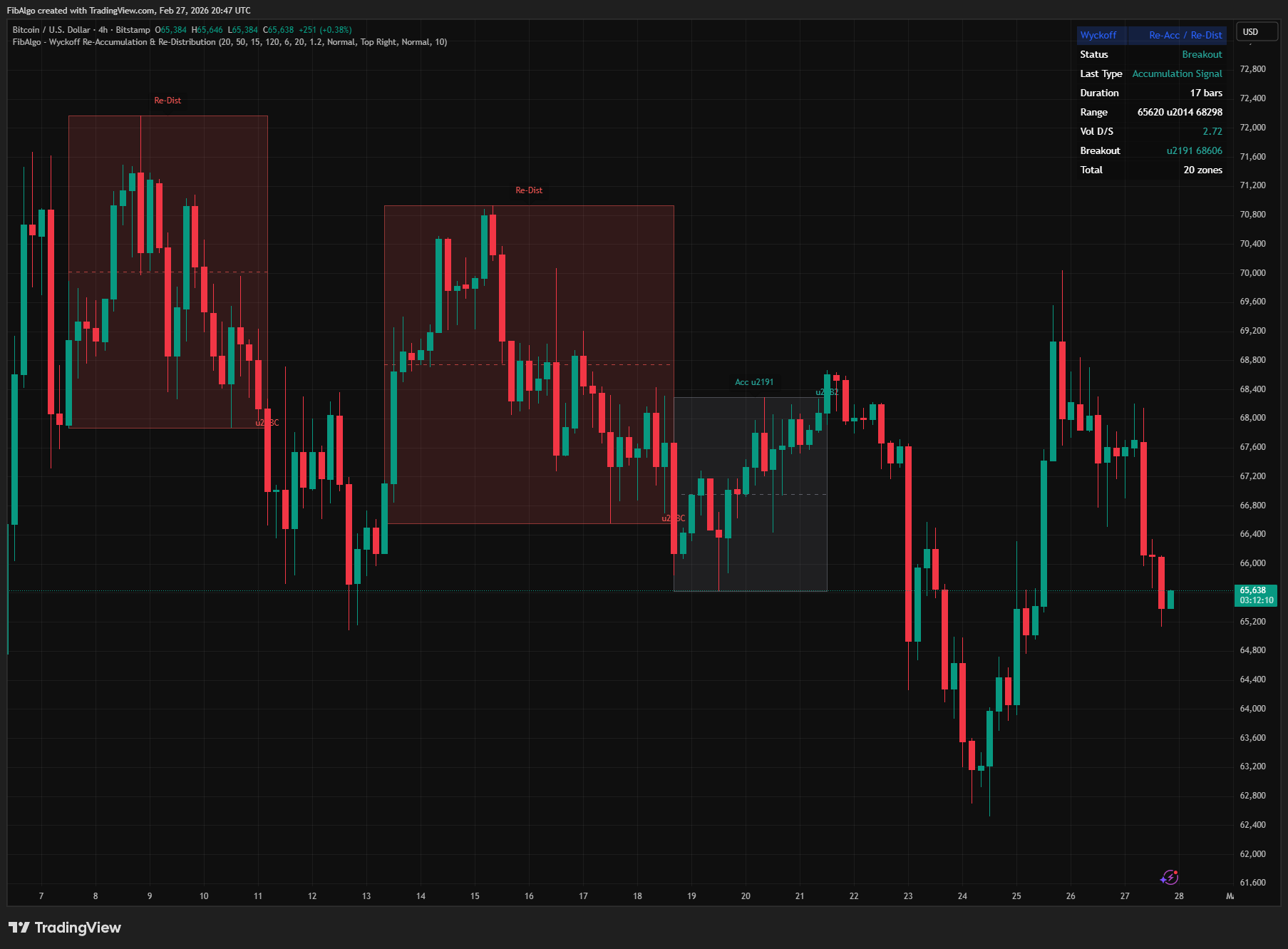
- Breakout Classification — When price closes outside the consolidation range, the prior trend and the breakout direction produce one of four classifications: Re-Accumulation (uptrend + up breakout), Re-Distribution (downtrend + down breakout), Distribution Warning (uptrend + down breakout), or Accumulation Signal (downtrend + up breakout). The volume D/S ratio is shown alongside as supporting evidence; it does not change the breakout classification.
How does the Wyckoff Re-Accumulation & Re-Distribution indicator work?
1. Prior Trend Detection Two exponential moving averages (default EMA 20 and EMA 50) establish the trend context before each consolidation. The trend is assessed on the bar just before the consolidation window:
- Fast EMA above Slow EMA, with the Slow EMA rising over the preceding Min Consolidation Bars = prior uptrend context
- Fast EMA below Slow EMA, with the Slow EMA falling over the preceding Min Consolidation Bars = prior downtrend context
- When the EMA order and the Slow EMA slope disagree (typical of sideways markets), no consolidation zone is started
- The trend assessment uses the EMA values from the bar just before the consolidation window, ensuring the classification reflects the actual trend state before the pause
- If EMA Fast Length is set higher than EMA Slow Length, the shorter length is used as the fast EMA automatically
2. Consolidation Detection The indicator uses a rolling, volatility-relative price-range analysis to detect when price enters a tight, range-bound consolidation:
- On each bar, the highest high and lowest low over the Min Consolidation Bars window (default 15) are calculated
- The range is expressed as a percentage of the mid-price: Range % = (Highest − Lowest) / Midpoint × 100, and must be at or below Max Range % (default 6.0%)
- The range must also be no wider than Max Range (x ATR) (default 2.5) times the ATR(50) measured on the bar just before the window. This keeps detection relative to each instrument's own volatility, so intraday, forex and low-volatility charts do not treat every window as a consolidation
- When both conditions are first met after a qualifying trend, a consolidation zone is initiated
- The zone starts from the first bar of the detection window and tracks forward until breakout, timeout, or invalidation
- A cooldown period equal to Min Consolidation Bars prevents overlapping detections
3. Volume Profile Analysis While the consolidation zone is active, the indicator continuously analyzes the volume character of each bar within the range:
- Demand bars (close > open): volume is attributed to buying pressure
- Supply bars (close < open): volume is attributed to selling pressure
- Doji bars (close = open): excluded from the volume profile to avoid noise
- Volume D/S Ratio = Total Demand Volume / Total Supply Volume
- Ratio above 1.0 = Demand Dominant (buyers absorbing supply — bullish for continuation in uptrend)
- Ratio below 1.0 = Supply Dominant (sellers overwhelming demand — bearish for continuation in downtrend)
- The forming zone label and info table update in real-time as new bars arrive, showing the tentative classification
- On symbols without volume data, the ratio is shown as "n/a" instead of a value
4. Breakout Detection & Classification A breakout occurs when the bar's close price exceeds the consolidation range boundaries:
- Close above zone high = upward breakout
- Close below zone low = downward breakout
- Breakout volume strength is assessed by comparing the breakout bar's volume to the Volume MA × Breakout Volume Multiple (default 1.2×)
- Strong volume breakout = higher confidence confirmation; weak volume = lower confidence
- Final classification combines prior trend direction + breakout direction:
- Uptrend + Up breakout = Re-Accumulation (stepping stone confirmed)
- Downtrend + Down breakout = Re-Distribution (stepping stone confirmed)
- Uptrend + Down breakout = Distribution Warning (potential trend reversal)
- Downtrend + Up breakout = Accumulation Signal (potential trend reversal)
- The Vol D/S ratio of the range is reported with every classification so you can check whether volume confirms it
5. Zone Lifecycle Management Each consolidation zone follows a defined lifecycle:
- Forming: zone is active, range and volume profile update each bar; it is drawn with the Forming / Warning fill and a dashed border, and the tentative classification is shown with a "?" suffix
- Breakout: price closes outside the range — zone is completed and classified
- Timeout: if the consolidation exceeds Max Consolidation Bars (default 120), it is classified by volume profile alone without breakout confirmation
- Invalidation: if the range expands beyond 1.5× the Max Range % threshold, or beyond 1.5× the ATR-based limit set when the zone started, the zone is discarded as a false detection
- A cooldown period prevents immediate re-detection after a zone completes
Features
- Automatic Consolidation Detection — Uses rolling price-range analysis, measured both as a percentage of price and against the prior ATR, to detect when an established trend enters a tight consolidation zone on any timeframe, without requiring manual drawing or subjective analysis
- EMA-Based Trend Context — Dual EMA order (default 20/50) plus the slope of the slow EMA establishes whether the prior trend was up or down, providing the essential Wyckoff context for classifying the consolidation
- Demand/Supply Volume Profiling — Classifies volume within consolidation zones by comparing total demand-bar volume versus supply-bar volume, revealing whether institutions are accumulating or distributing during the pause
- Four-Way Zone Classification — Combines prior trend direction and breakout direction to classify zones as Re-Accumulation, Re-Distribution, Distribution Warning, or Accumulation Signal
- Real-Time Forming Zones — Active consolidations are drawn with dashed borders and shown with tentative classification ("Re-Acc ?", "Re-Dist ?") that updates as new volume data arrives, enabling traders to prepare before breakout
- Breakout Volume Strength — Each breakout is assessed for volume confirmation by comparing breakout bar volume against the average volume × a configurable multiplier, with "Strong Vol" or "Weak Vol" shown in tooltips
- Zone Boxes with Midline — Each consolidation zone is drawn as a colored box (green for Re-Acc, red for Re-Dist, gray for warnings/forming) with an optional dashed midline showing the range center
- Breakout Arrows — Optional triangle markers (▲ for upward, ▼ for downward) at the breakout bar provide instant visual identification of breakout direction
- Detailed Tooltips — Hovering over any zone label reveals comprehensive details including classification, prior trend, duration, exact range, volume D/S ratio, volume bias, breakout price, and breakout volume strength
- Range Expansion Invalidation — Zones that expand beyond 1.5× the Max Range % or 1.5× the ATR-based limit are automatically invalidated, preventing false consolidation detection in volatile conditions
- Max Zone Display Control — Configurable maximum number of displayed zones (default 5) keeps the chart clean while showing the most recent stepping stone patterns
- Info Table (8 rows) — Real-time dashboard showing current status (Forming/Breakout/Timeout), zone type, duration, price range, volume D/S ratio, prior trend direction, and total zones detected, readable on both light and dark chart themes
- Alert System — Three configurable alerts: Re-Accumulation identified, Re-Distribution identified, and generic Breakout from Stepping Stone. Alerts are sent once the breakout bar closes, and each message includes the breakout price, the zone range and the Vol D/S ratio. The generic breakout alert covers every breakout not already sent by an enabled Re-Accumulation or Re-Distribution alert and names the classification and direction
How to use the Wyckoff Re-Accumulation & Re-Distribution indicator
- Add the indicator to your chart. It overlays colored boxes on consolidation zones detected within established trends.
- Look for green Re-Acc boxes during uptrends — these are Wyckoff "stepping stones" where the Composite Man is likely adding to positions before the next markup leg. The volume D/S ratio should be above 1.0 (demand dominant).
- Look for red Re-Dist boxes during downtrends — these are stepping stones where the Composite Man may be adding to short positions before the next markdown leg. The volume D/S ratio should be below 1.0 (supply dominant).
- Pay attention to forming zones (dashed borders with "?" suffix). If the volume profile matches the expected pattern for the trend, prepare for a breakout in the trend direction.
- When a Distribution Warning appears (gray box in an uptrend with down breakout), this signals a potential trend reversal — the consolidation was not Re-Accumulation but rather genuine Distribution. Consider reducing long exposure.
- When an Accumulation Signal appears (gray box in a downtrend with up breakout), this signals a potential trend reversal — the consolidation was not Re-Distribution but perhaps the start of genuine Accumulation.
- Check the Volume D/S ratio in the tooltip or info table. Values above 1.2 indicate strong demand dominance; below 0.8 indicate strong supply dominance. Values near 1.0 are neutral and less conclusive. A Re-Accumulation with a supply-dominant ratio, or a Re-Distribution with a demand-dominant ratio, is not confirmed by volume.
- Use the Breakout Volume Strength indicator in tooltips: "Strong Vol" breakouts have higher follow-through probability than "Weak Vol" breakouts according to Wyckoff methodology.
- Combine with Accumulation & Distribution (#1) for phase identification, SOS & SOW (#6) for demand/supply events within the range, and VSA (#3) for detailed bar-by-bar volume analysis.
- Max Range (x ATR) adapts detection to each instrument's volatility automatically: lower it (2.0) to keep only the tightest pauses, raise it (3.0-4.0) to include wider ranges. Max Range % works as an extra upper cap; on high-volatility daily or weekly charts such as crypto, raise it (10-15%) so it does not block valid ranges.
- Adjust Min Consolidation Bars based on timeframe: shorter (8-12) for intraday charts, longer (20-30) for weekly charts.
Limitations
- This indicator does not generate buy or sell signals. It identifies consolidation patterns within trends and classifies them based on Wyckoff methodology for educational and analytical purposes.
- Consolidation detection uses a rolling price-range method, which is a simplified approximation of Wyckoff's trading range identification. Real-world trading ranges may have complex internal structures (springs, upthrusts, secondary tests) that this indicator does not individually identify — use the Accumulation & Distribution indicator (#1) for detailed event detection.
- The volume D/S ratio uses a simple close-above-open / close-below-open classification. In markets with frequent doji bars, the volume profile may exclude a significant portion of the total volume.
- The EMA crossover for trend detection is a lagging indicator. In choppy or transitional markets, the trend classification may not accurately reflect the true market condition at consolidation start.
- Low Max Range (x ATR) values (below 2) may produce few or no detections; high values (above 4) may classify ordinary price swings as consolidations. A tight Max Range % can block detections on volatile instruments regardless of the ATR setting. Adjust based on instrument volatility.
- Timeout zones (exceeding Max Consolidation Bars) are classified by volume profile only without breakout confirmation, making them less reliable than breakout-confirmed zones.
- On symbols without volume data (for example some indices), the Vol D/S ratio is shown as n/a, breakout volume strength is not reported, and forming or timed-out zones default to the trend-continuation type.
- The forming zone and a breakout on the current, unfinished bar can change until that bar closes; alerts are sent only after the bar closes.
- Past consolidation patterns do not guarantee future trend continuation. A Re-Accumulation classification can still fail if broader market conditions change.
Trading involves risk. This indicator is an analysis tool, not financial advice: use it alongside your own analysis and risk management.
Release notes
v2.1LatestSymbols instead of text codes in the table, labels and alerts
Symbols that appeared as text codes such as u2014 or u2191 now show as intended, with no change to calculations, signals, alert timing or settings.
After updating
- Delete and re-create your alerts for this indicator to get the symbols in alert messages. TradingView alerts keep running the script version they were created with.
Fixed
- The info table, zone labels, tooltips and breakout markers now show —, ↑, ↓, ▲ and ▼ instead of text codes, for example "Acc ↑" instead of "Acc u2191".
- Alert messages now show — and ↑ or ↓ instead of u2014, u2191 or u2193.
v2.0Bar-close breakout alerts and ATR-based range detection
Alerts are sent only when the breakout bar closes, ranges must also fit within a multiple of the prior ATR, and the trend context requires the slow EMA to slope with the trend.
After updating
- Delete and re-create your alerts for this indicator with the "Any alert() function call" condition. TradingView alerts keep running the script version they were created with.
Fixed
- Alerts are sent only when the breakout bar closes. Before, a wick through the range could send an alert even if the bar closed back inside.
- The Breakout alert now covers every breakout not already sent by another enabled alert, and messages include the direction, range and Vol D/S.
- Volume gaps and symbols without volume are handled (shown as n/a), zones no longer start one bar early, and the Total count, table text on light themes, forming box color and Dist Warn label (which used an emoji-style symbol) are corrected.
Improved
- Detection: the range must also fit within a multiple of the prior ATR, so intraday and low-volatility charts no longer flag almost every window.
- Trend context: the slow EMA must slope in the trend direction, no trend is read while the EMAs warm up, and swapped EMA lengths no longer invert it.
Added
- A Max Range (x ATR) setting in the Detection group, default 2.5. For high-volatility daily crypto charts the description suggests a Max Range % of 10 to 15.
Changed
- Expect far fewer zones on intraday, forex and low-volatility charts, and fewer on daily stock charts, because only genuinely narrow ranges qualify now.
Frequently Asked Questions
What is the Wyckoff Re-Accumulation & Re-Distribution indicator?
TradingView indicator that detects Wyckoff Re-Accumulation and Re-Distribution patterns — consolidation pauses within established market trends.
Is Wyckoff Re-Accumulation & Re-Distribution free to use on TradingView?
Yes, Wyckoff Re-Accumulation & Re-Distribution is completely free to use. You can add it directly to your TradingView charts at no cost.
How do I add Wyckoff Re-Accumulation & Re-Distribution to my TradingView chart?
Open TradingView, click on "Indicators" at the top of your chart, search for "Wyckoff Re-Accumulation & Re-Distribution" by FibAlgo, and click to add it. It will appear on your chart immediately.
What trading strategies work best with Wyckoff Re-Accumulation & Re-Distribution?
Wyckoff Re-Accumulation & Re-Distribution is commonly used for Wyckoff Method, Trend, and Volume Based analysis. It works well as part of a multi-indicator confirmation strategy on any timeframe.
Learn More
- Smart Money Concepts (SMC): How Institutional Traders Move MarketsLearn Smart Money Concepts including order blocks, fair value gaps, liquidity sweeps, and breaker blocks. Understand how institutions trade.
- Technical Analysis for Crypto Trading: The Definitive GuideLearn technical analysis from basics to advanced for cryptocurrency trading. Master chart patterns, indicators, volume analysis, and multi-timeframe strategies.
- Risk Management in Crypto Trading: The Complete Survival GuideMaster position sizing, stop losses, portfolio allocation, and emotional discipline for crypto trading. Learn why risk management matters most.
Start Using Wyckoff Re-Accumulation & Re-Distribution
This indicator is free to use on TradingView. Add it to your charts and use it alongside your own analysis.
Related indicators
View All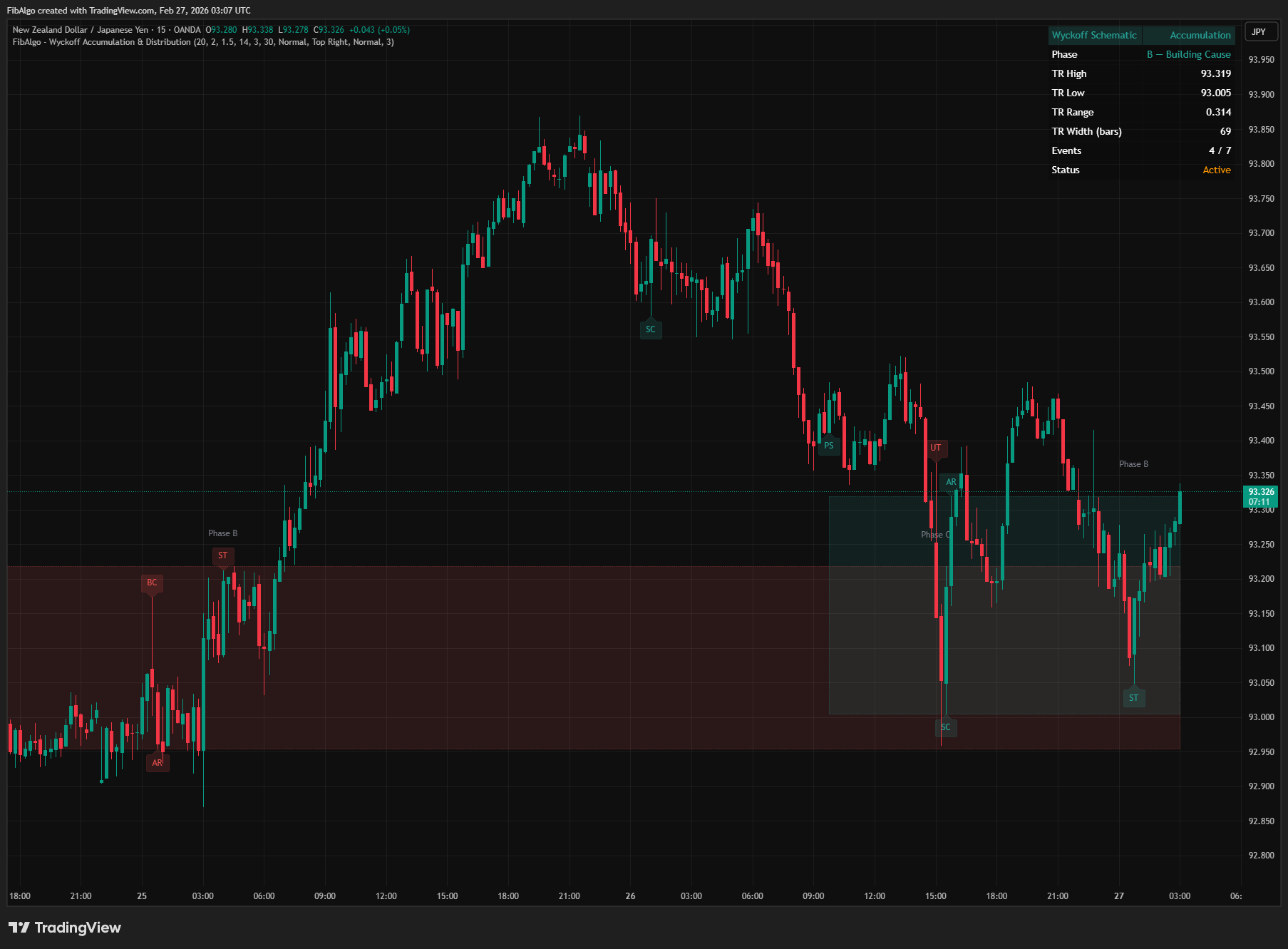
Wyckoff Accumulation & Distribution
TradingView indicator that automatically detects Wyckoff Accumulation and Distribution schematics as each bar closes, with phase classification (A through E).
See Details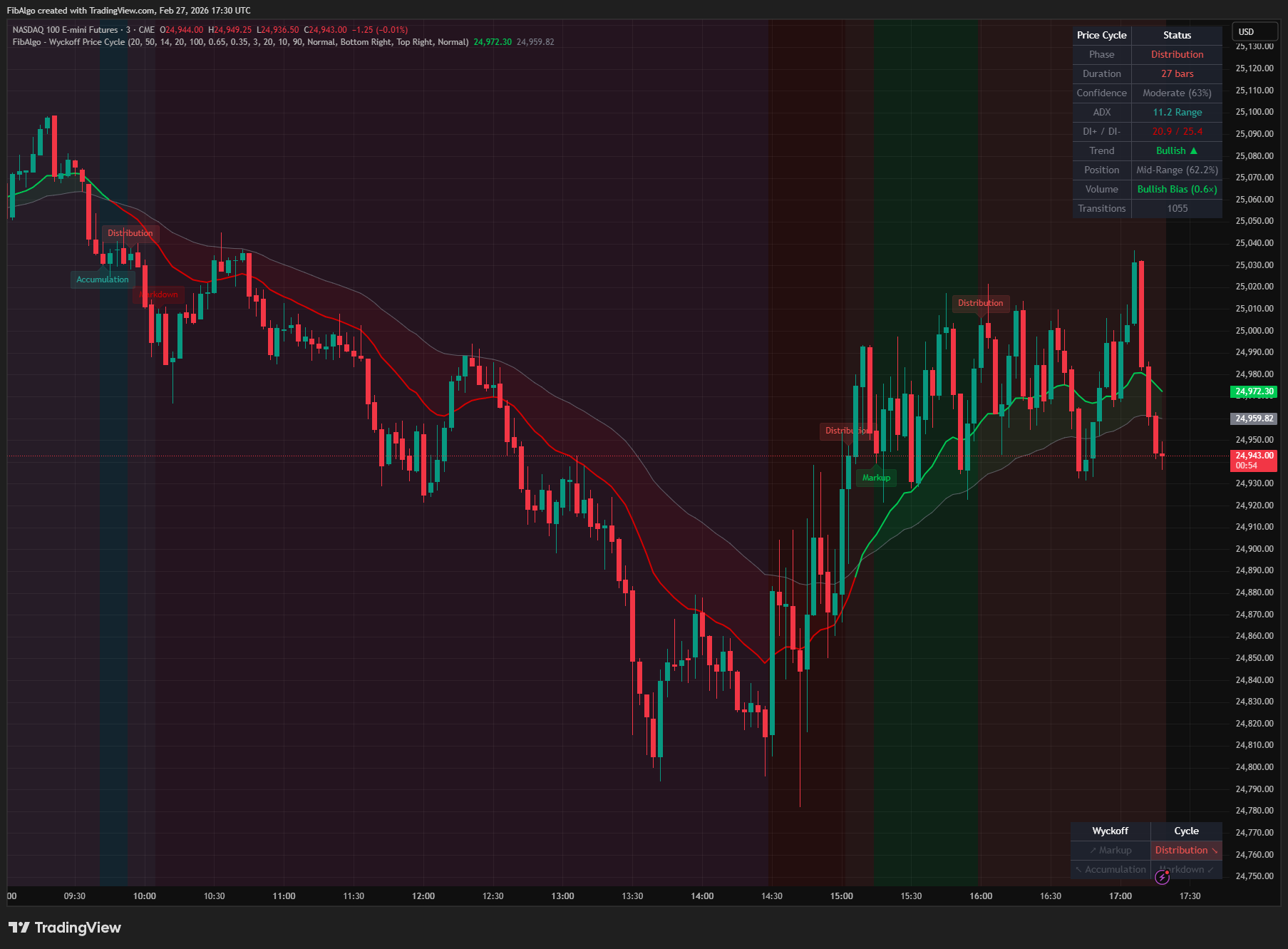
Wyckoff Price Cycle
TradingView indicator that identifies the four Wyckoff market cycle phases — Accumulation, Markup, Distribution, and Markdown — confirmed on closed bars.
See Details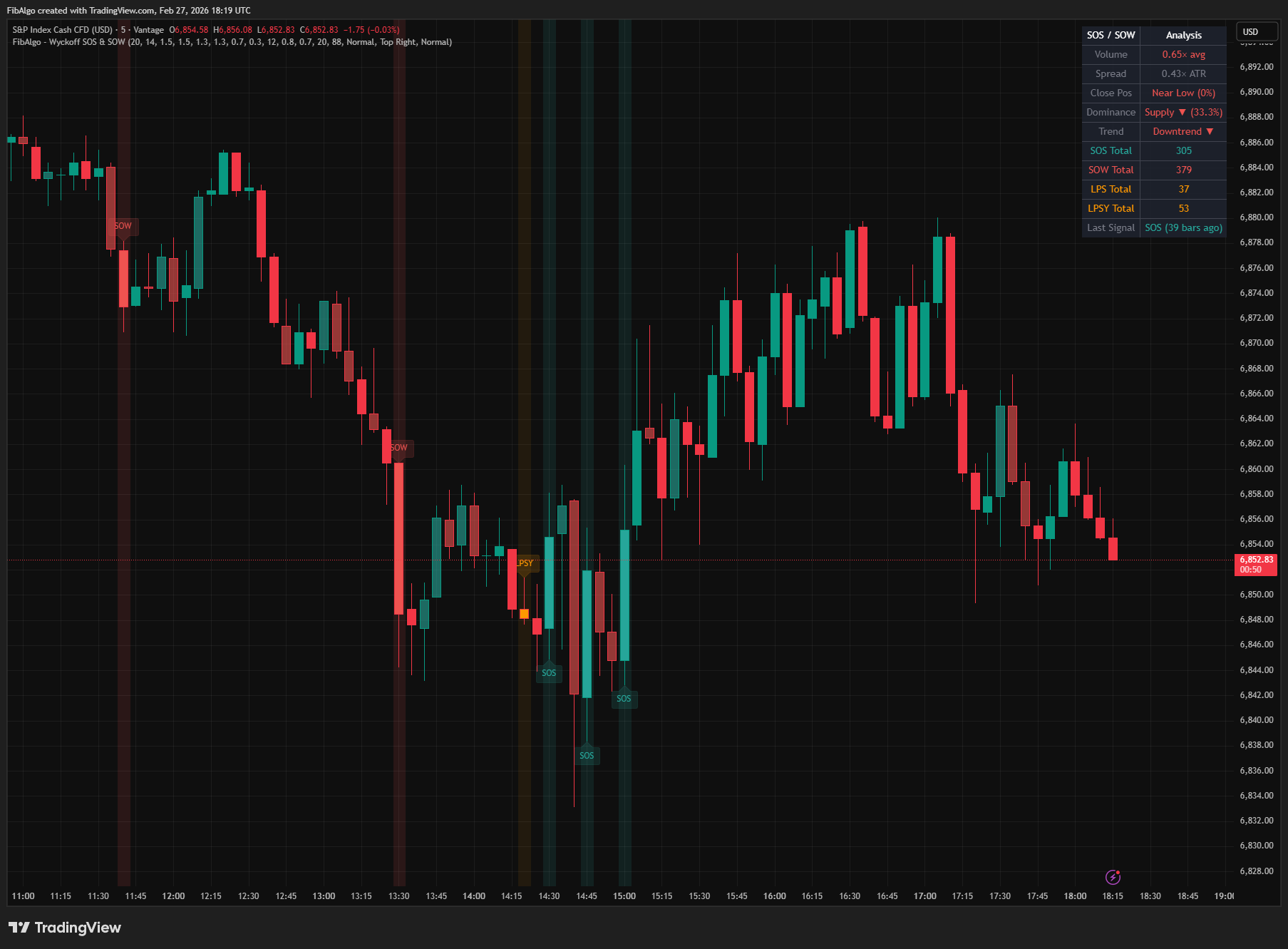
Wyckoff SOS & SOW
TradingView indicator that identifies Wyckoff Sign of Strength (SOS) and Sign of Weakness (SOW) events with LPS/LPSY confirmations.
See Details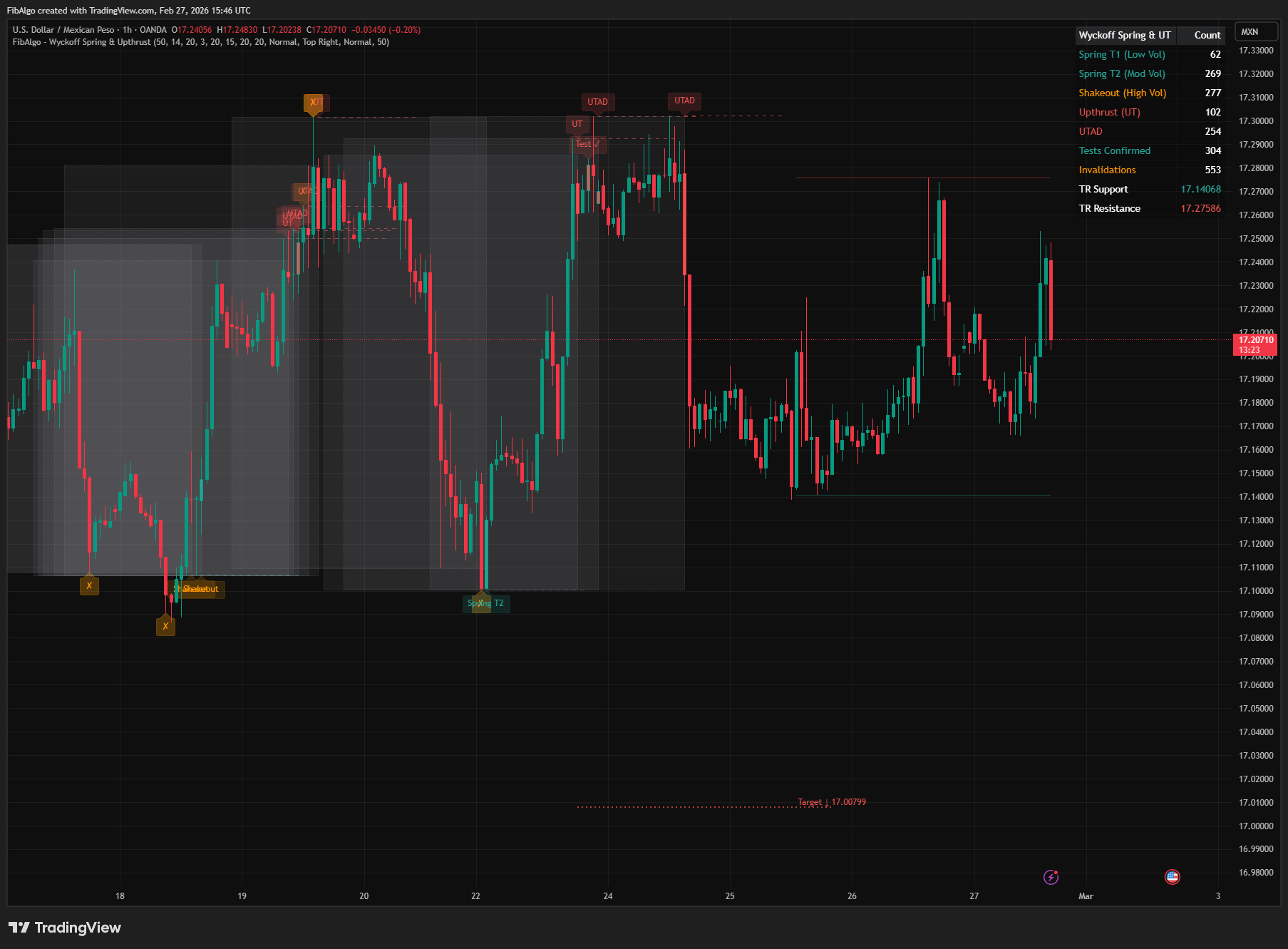
Wyckoff Spring & Upthrust
TradingView indicator that detects Wyckoff Springs and Upthrusts — the two most actionable reversal events with volume classification and price targets.
See Details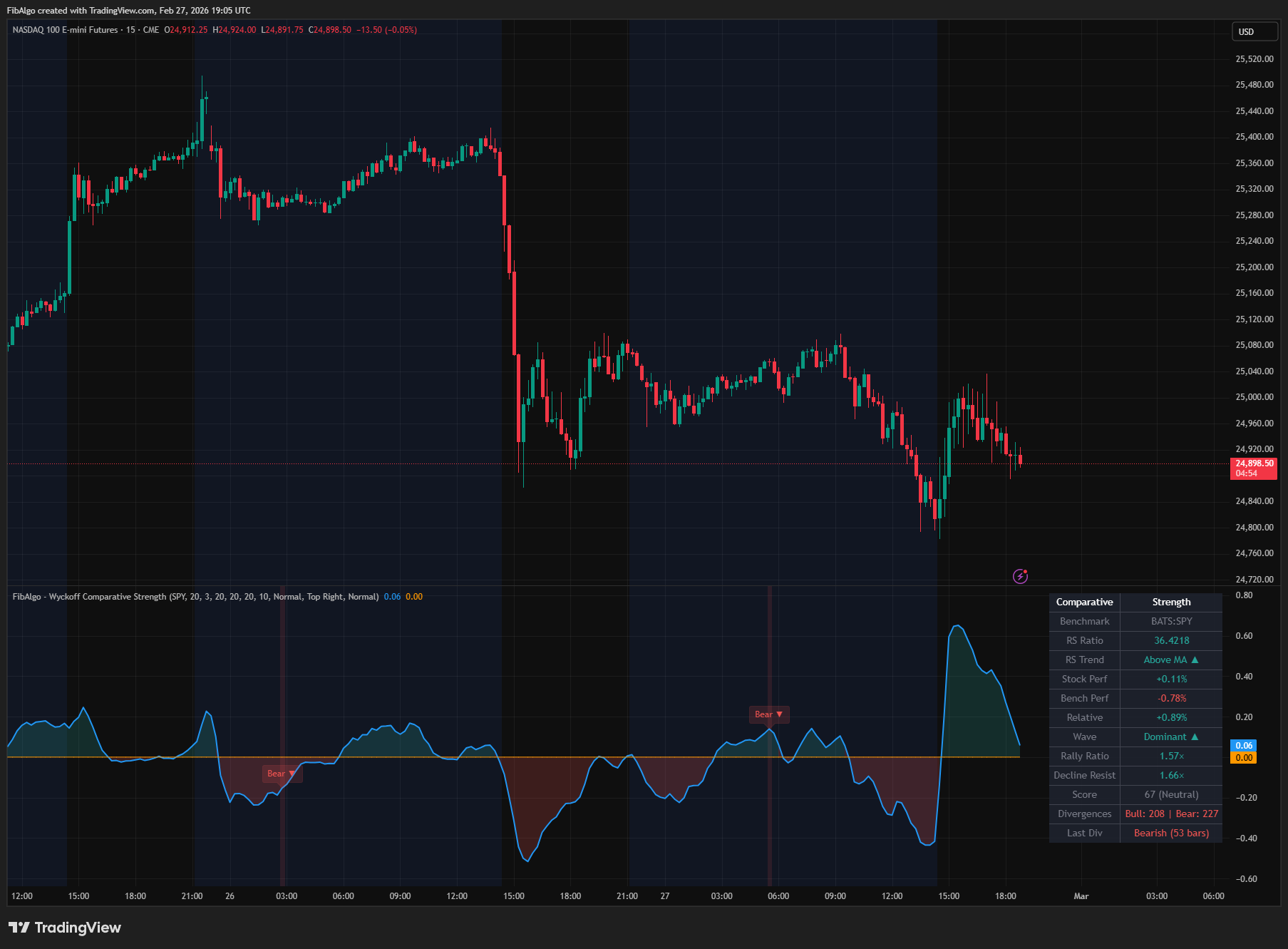
Wyckoff Comparative Strength
TradingView indicator that measures Wyckoff Comparative Strength — relative performance vs benchmark with RS oscillator and divergence analysis.
See Details