
Use this indicator directly on TradingView — the world's most popular charting platform.
What does the Wyckoff Accumulation & Distribution indicator do?
This indicator automatically detects and labels Wyckoff Accumulation and Distribution schematics as each bar closes. It identifies the key events defined by Richard D. Wyckoff's methodology — including Selling Climax (SC), Buying Climax (BC), Automatic Rally/Reaction (AR), Secondary Tests (ST), Springs, Upthrusts, Signs of Strength (SOS), Signs of Weakness (SOW), and more — then assigns the correct phase (A through E) as the schematic unfolds. A color-coded trading range box and info table provide instant visual context.
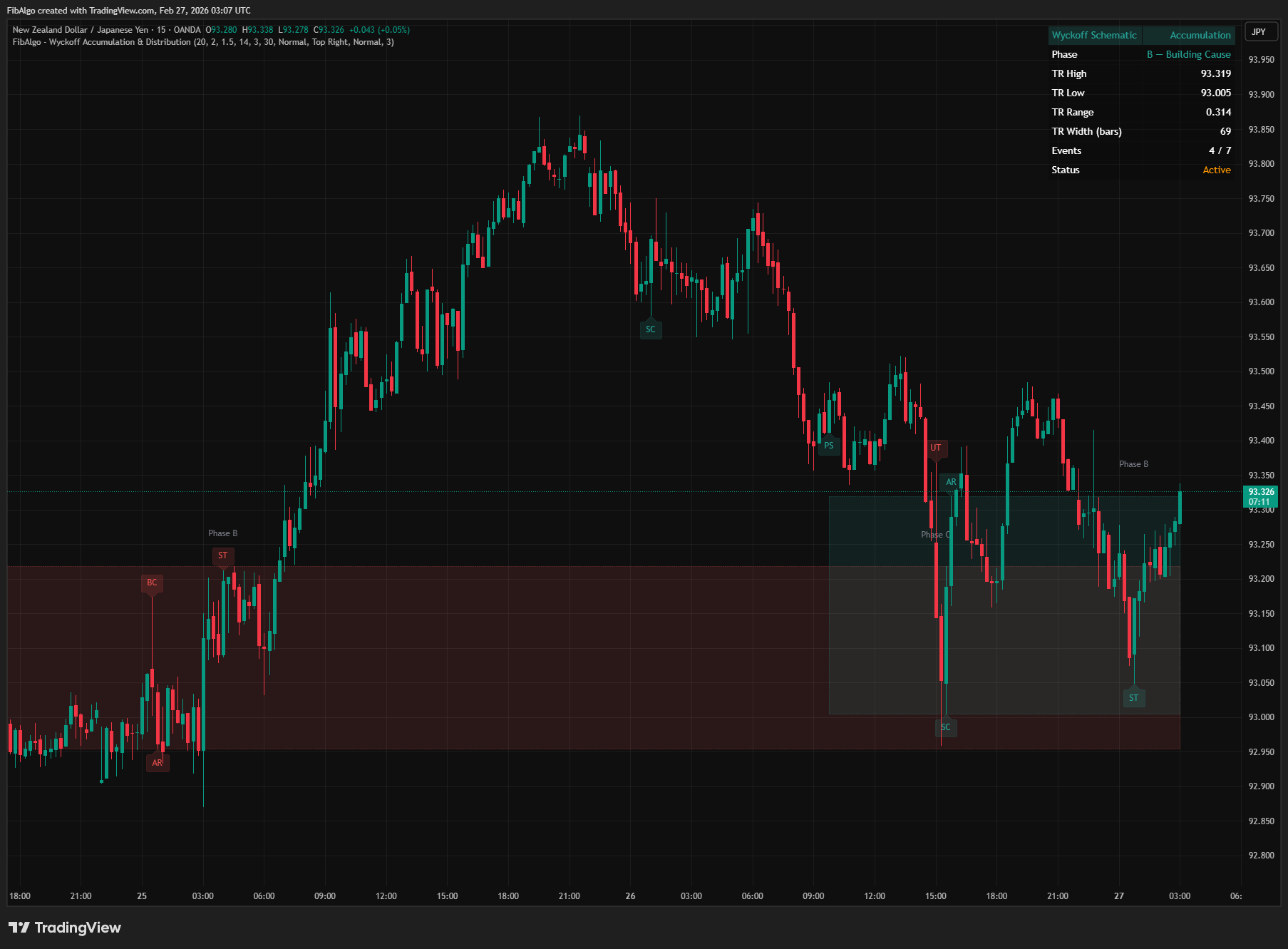
Key Concepts
- Wyckoff Accumulation — A sideways trading range at the bottom where institutional interests absorb supply. The Composite Man quietly accumulates inventory before a markup phase begins.
- Wyckoff Distribution — A sideways trading range at the top where institutional interests offload positions. The Composite Man distributes holdings before a markdown phase begins.
- Five Phases (A–E) — Each schematic progresses through five phases: A (stopping the trend), B (building cause), C (testing supply/demand via spring or upthrust), D (demand/supply dominance), and E (trend begins).
- Volume Confirmation — Climaxes, secondary tests and signs of strength/weakness are validated with volume, and last points of support/supply with low volume or a narrow spread. Climaxes require extreme volume, secondary tests require diminishing volume, and signs of strength/weakness require expanding volume. Springs and Upthrusts are price tests of the range edges.
How does the Wyckoff Accumulation & Distribution indicator work?
1. Trend Assessment The indicator evaluates the prior trend using a dual SMA crossover method (half-period vs full-period moving averages). A confirmed downtrend triggers accumulation detection; a confirmed uptrend triggers distribution detection. This approach identifies genuine directional momentum rather than simple price positioning.
2. Accumulation Schematic Detection Events are detected sequentially as the schematic unfolds:
- Phase A — Stopping the Downtrend: Preliminary Support (PS) shows first buying interest — bullish bar closing near its high (above the 60% level) on above-average volume. A PS that is not followed by a Selling Climax within the Trend Lookback expires. Selling Climax (SC) marks maximum panic selling absorbed by institutions — extreme volume, wide spread, close in the upper half of the bar (absorption signature), and the lowest low of the recent swing (half the Trend Lookback, minimum 5 bars). Automatic Rally (AR) follows swiftly as selling pressure exhausts; the TR resistance follows the highest high of the rally until the Secondary Test. Secondary Test (ST) revisits the SC zone on both diminished volume AND narrower spread than the SC bar, and closes at or above the SC low. If no AR is detected within a reasonable window, the schematic is automatically invalidated.
- Phase B — Building the Cause: Price oscillates within the trading range. The indicator expands visual TR boundaries with a configurable tolerance while preserving the original SC/ST reference levels for Phase C detection.
- Phase C — Spring: Price breaks below the original reference support level (SC/ST low, unaffected by Phase B tolerance) and closes back above it, either on the same bar or within 3 bars after the first close below — a bear trap. The Spring label is placed at the lowest point of the break. If price closes below support and does not recover within 3 bars (checked from the AR onward), or later closes below the Spring low, the schematic is invalidated. Wyckoff practitioners treat the Spring as the key test of remaining supply.
- Phase D — Demand Dominates: Sign of Strength (SOS) is a wide-spread bullish bar closing near its high on above-average volume, moving above the mid-TR. Last Point of Support (LPS) is a pullback bar (a lower low than the previous bar) on diminished volume or narrow spread that holds above the midpoint.
- Phase E — Markup: On a bar after the SOS, price closes above the reference resistance level (AR high) on above-average volume with a bullish bar, confirming the accumulation is complete.
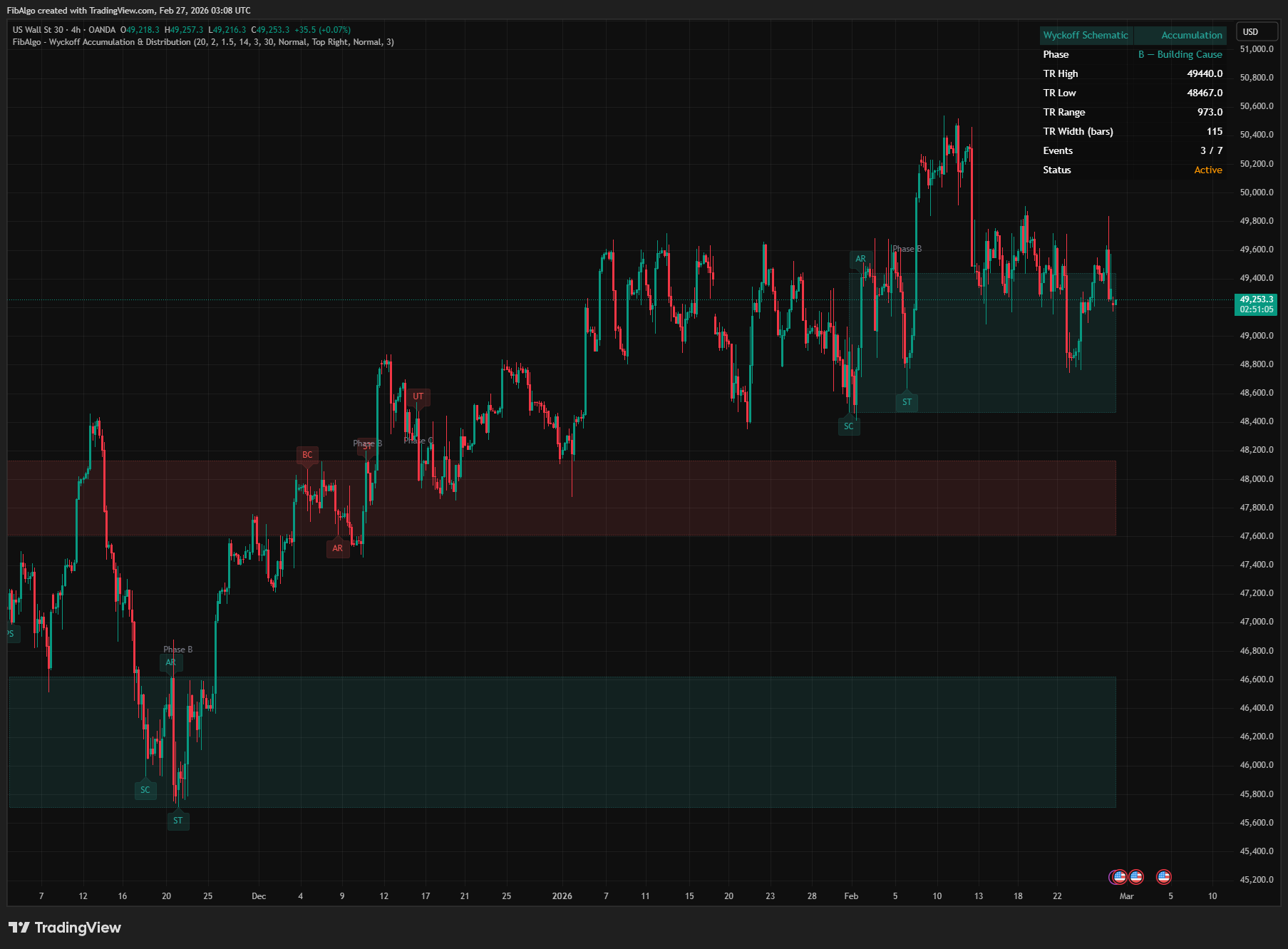
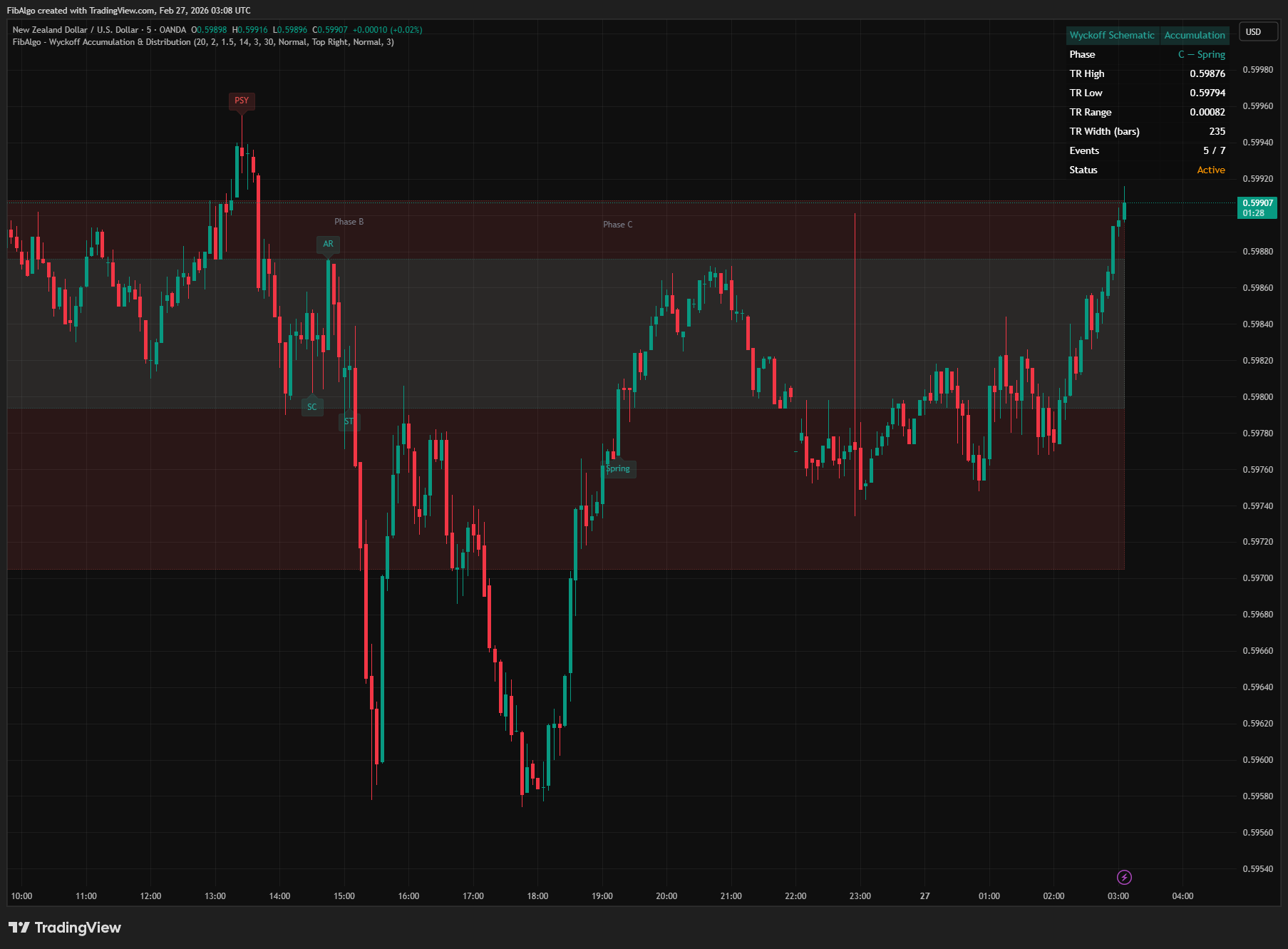
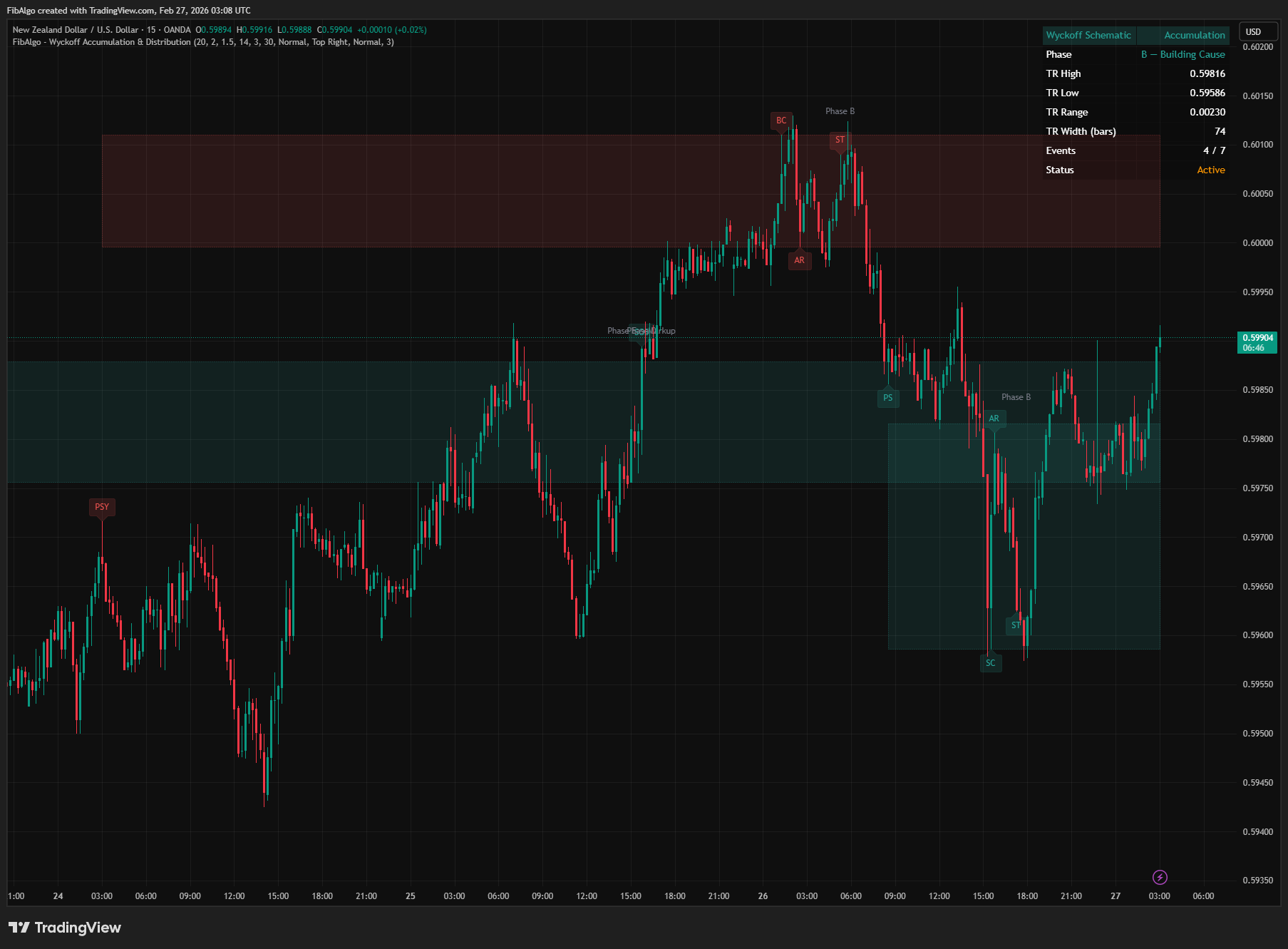
3. Distribution Schematic Detection The mirror image of accumulation:
- Phase A: Preliminary Supply (PSY) shows first selling with close in the lower 40% of bar; it expires if no Buying Climax follows within the Trend Lookback. Buying Climax (BC) has extreme volume, wide spread, close in the lower half (failure signature), and the highest high of the recent swing. Automatic Reaction (AR) follows swiftly; the TR support follows the lowest low of the reaction until the Secondary Test. Secondary Test (ST) revisits the BC zone on both diminished volume AND narrower spread, and closes at or below the BC high.
- Phase B: Range-bound consolidation. Visual TR expands while original BC/AR reference levels are preserved for Phase C.
- Phase C: Upthrust (UT) — price breaks above the reference resistance level (BC/ST high) and closes back below it, either on the same bar or within 3 bars after the first close above. A bull trap. The UT label is placed at the highest point of the break. If price closes above resistance and does not fall back within 3 bars (checked from the AR onward), or later closes above the UT high, the schematic is invalidated.
- Phase D: Sign of Weakness (SOW) is a wide-spread bearish bar closing near its low on above-average volume below mid-TR. Last Point of Supply (LPSY) is a feeble rally bar (a higher high than the previous bar) on diminished volume or narrow spread that fails below mid-TR.
- Phase E: On a bar after the SOW, markdown begins as price closes below the reference support level (AR low) on above-average volume with a bearish bar.
4. Trading Range Box A color-coded box (green for accumulation, red for distribution) marks the detected trading range boundaries. The box of an active schematic extends in real-time as the schematic develops; the box of a completed or invalidated schematic ends at its last bar.
5. Info Table A summary table shows the current schematic type, phase, TR boundaries, range size, width in bars, event count, and status (Active, Complete or Invalidated). The table follows the chart theme, so it is readable on dark and light charts. On symbols without volume data it shows a notice instead.
Features
- Automated Schematic Detection — Identifies both accumulation and distribution schematics automatically using volume, spread, and price position analysis.
- Full Event Labeling — Labels all 14 Wyckoff events: PS, SC, AR, ST, Spring, SOS, LPS (accumulation) and PSY, BC, AR, ST, UT, SOW, LPSY (distribution).
- Phase Tracking (A–E) — Assigns and displays the correct phase as the schematic unfolds, providing real-time context.
- Trading Range Box — Color-coded box marking TR boundaries that extends dynamically as new events are detected.
- Volume & Spread Confirmed Events — Climaxes, secondary tests and SOS/SOW require both a volume and a spread condition; LPS/LPSY require low volume or a narrow spread; the AR uses spread and distance from the climax. Climaxes require extreme volume with specific close positioning (upper half for SC absorption, lower half for BC failure). Secondary tests compare both volume AND spread to the original climax bar. Springs and Upthrusts are price tests: a break of the range edge that closes back inside.
- Reference Level Separation — Phase B visual TR expansion does not affect the original SC/ST or BC/AR reference levels used for Spring and Upthrust detection, preventing false signals from tolerance drift.
- Automatic Invalidation — Schematics that fail to progress (no AR detected within the expected window, a PS/PSY without a climax, a range that stays broken, a failed Spring/Upthrust, or no event activity for an extended period) are automatically invalidated and shown as Invalidated in the table.
- Configurable Detection — Volume multiplier, spread multiplier, TR tolerance, and trend lookback are all adjustable.
- Per-Event Toggle — Show or hide each individual event type independently for both accumulation and distribution.
- Info Table — Summary dashboard showing schematic type, phase, TR metrics, event count, and active/complete/invalidated status.
- Multi-Schematic Support — Keeps up to 10 schematics on the chart (one active accumulation and one active distribution at a time), removing invalidated and completed ones first.
- Comprehensive Alerts — Alerts for climax events, springs, upthrusts, SOS/SOW, and phase transitions, sent when the bar closes. Messages include the symbol, timeframe and price levels.
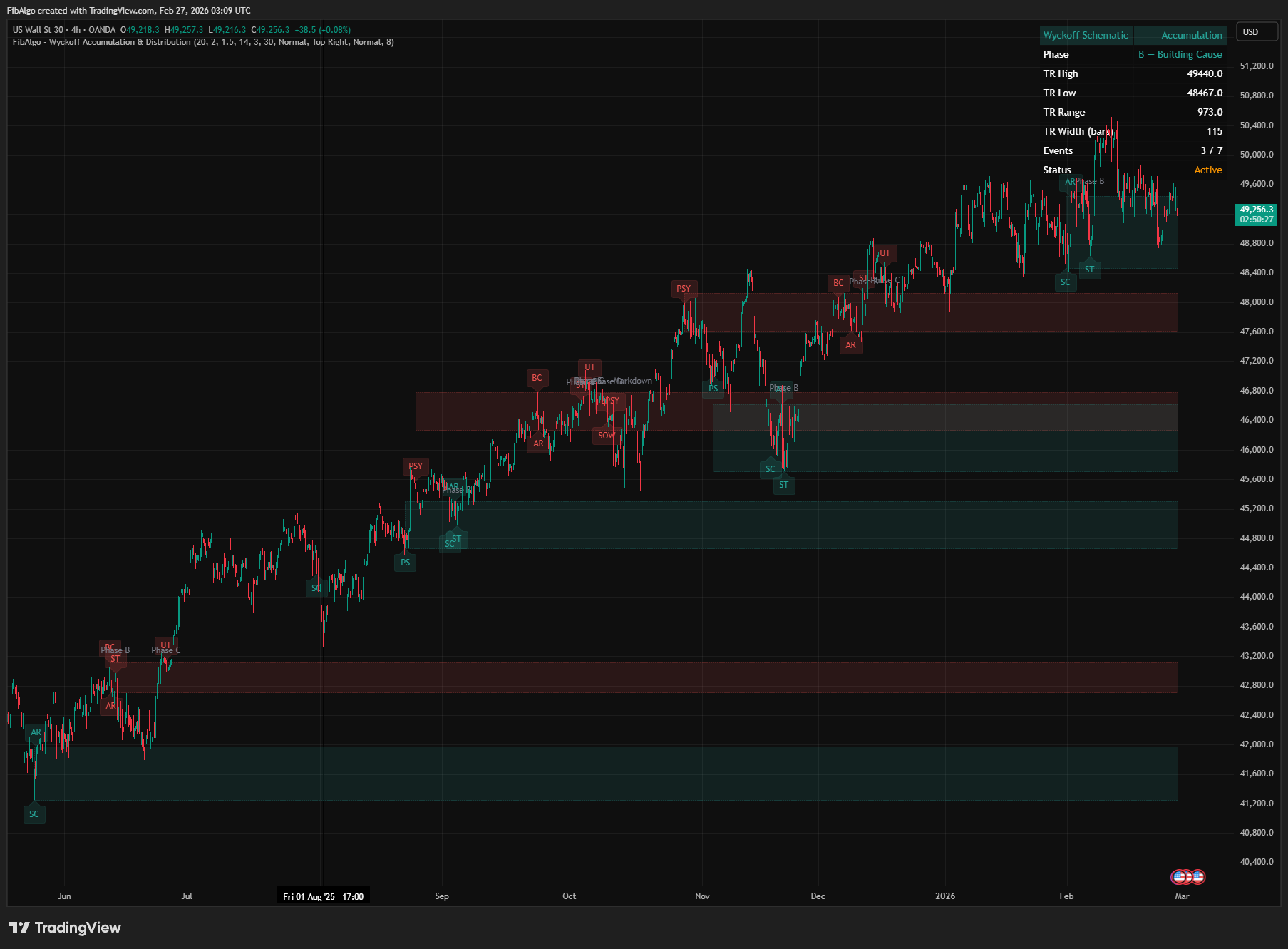
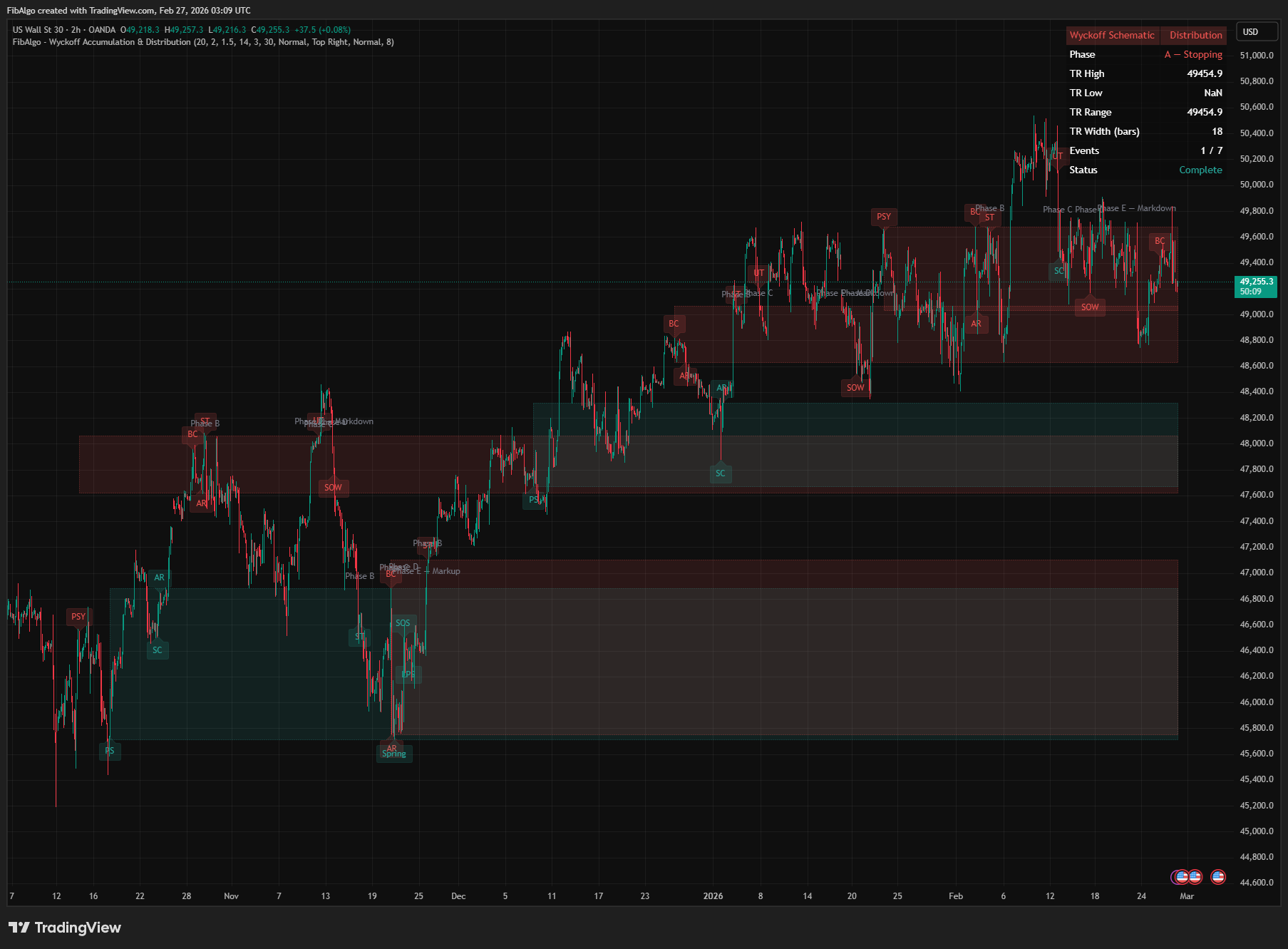
How to use the Wyckoff Accumulation & Distribution indicator
- Apply the indicator to any liquid market (futures, forex, stocks, crypto) with volume data, on any timeframe in the 5-minute to daily range.
- Watch for Phase A events (SC/BC + AR + ST) to identify potential trading ranges forming.
- The key Phase C events are Springs in accumulation and Upthrusts in distribution.
- After a Spring, look for SOS confirmation before taking long positions. After an Upthrust, look for SOW to confirm shorts.
- Use the Phase label to understand where you are in the schematic — avoid entries in Phase B (too early, range is still building).
- The Info Table provides a quick summary — when Events shows 5/7 or higher with an active status, the schematic is well-developed.
- Adjust Climax Volume Multiplier if your market has unusually high or low volume spikes.
Limitations
- This indicator does not generate buy or sell signals. It identifies Wyckoff schematic events for educational and analytical purposes.
- Wyckoff schematics are complex and subjective — automated detection provides a starting framework, not a definitive analysis.
- Not all accumulation/distribution ranges contain every event. PS/PSY is optional, but Phase D and E are only reached after a detected Spring/UT; ranges without one stay in Phase B until they time out.
- Phase B can be prolonged and may show false Spring/UT-like moves before the actual Phase C event.
- Schematics that fail to produce an Automatic Rally/Reaction within the expected window, whose range breaks without recovery, or that go without new events for an extended period are automatically invalidated.
- Volume data is required. On symbols without volume no events are detected and the table shows a notice. Illiquid or low-volume instruments may produce unreliable readings.
- Events are evaluated when a bar closes: labels and alerts appear on the closed bar and are not redrawn afterwards. A Spring or Upthrust is confirmed on the bar that closes back inside the range, and its label is placed on the extreme bar of the break, up to 3 bars earlier.
- The indicator is designed for educational use to help traders learn and apply the Wyckoff method.
Trading involves risk. This indicator is an analysis tool, not financial advice: use it alongside your own analysis and risk management.
Release notes
v2.0LatestClosed-bar events, stricter Spring/UT and invalidation
Events and alerts now use closed bars only, a Spring or Upthrust needs a close back inside the range within 3 bars, and a range that stays broken invalidates the schematic.
After updating
- Delete and re-create your alerts for this indicator with the "Any alert() function call" condition. TradingView alerts keep running the script version they were created with.
- Alert messages now start with the symbol and timeframe. If you filter alert messages automatically, for example through a webhook, update your filters.
Fixed
- Events and alerts use closed bars only, so nothing appears on the live bar and then vanishes.
- A Spring or Upthrust needs a close back inside the range within 3 bars. A range that stays broken, or a later close beyond the Spring/UT extreme, now invalidates the schematic instead of letting it continue to Phase D and E.
- Phase E no longer fires on the SOS/SOW bar, and phase text no longer overlaps event labels.
- Finished boxes end at their last bar, and an active range is never removed. The table shows invalidated schematics, no NaN values, and reads well on light charts.
Improved
- The AR range edge follows the whole rally or reaction until the ST. The SC and BC must be a swing extreme, the ST must close inside the range, and LPS/LPSY need a pullback or rally bar.
- Alerts show the symbol, timeframe and price levels, and symbols without volume data show a notice in the table.
Frequently Asked Questions
What is Wyckoff accumulation?
Wyckoff accumulation is a sideways trading range after a decline, in which large operators, Wyckoff's Composite Man, absorb the available supply before prices mark up. It usually starts with a selling climax and an automatic rally, builds a cause in phase B, tests supply with a spring and ends when price breaks out above the range. The indicator labels these events as each bar closes.
What is the difference between Wyckoff accumulation and distribution?
Distribution is the mirror image of accumulation. Accumulation forms after a decline and leads to a markup; distribution forms after an advance, while large operators sell their holdings, and leads to a markdown. The events mirror each other too: a selling climax becomes a buying climax, a spring becomes an upthrust and a sign of strength becomes a sign of weakness. The indicator draws accumulation ranges in green and distribution ranges in red.
What are the five Wyckoff phases?
Phase A stops the prior trend with the climax, the automatic rally or reaction and the secondary test. Phase B builds the cause while price moves sideways inside the range. Phase C tests the range with a spring in accumulation or an upthrust in distribution. Phase D shows demand or supply taking control through signs of strength or weakness and last points of support or supply. Phase E is the new trend leaving the range.
Which Wyckoff events does the indicator label?
It labels 14 events: preliminary support (PS), selling climax (SC), automatic rally (AR), secondary test (ST), spring, sign of strength (SOS) and last point of support (LPS) in accumulation; preliminary supply (PSY), buying climax (BC), automatic reaction (AR), secondary test (ST), upthrust (UT), sign of weakness (SOW) and last point of supply (LPSY) in distribution. Climaxes, secondary tests and signs of strength or weakness are checked against volume and spread, last points of support or supply against volume or spread, and springs and upthrusts are price tests; each type can be shown or hidden.
What is a Wyckoff spring?
A spring is the phase C test of an accumulation: price drops below the range's support, set by the selling climax or secondary test low, but closes back inside the range within three bars and traps the sellers. If price stays below support instead, the indicator invalidates the schematic. Wait for a sign of strength after the spring before considering long positions; the mirror event in distribution is the upthrust, confirmed by a sign of weakness.
Which markets and timeframes suit Wyckoff schematics?
The indicator works on any liquid market with volume data, such as futures, forex, stocks or crypto, from the 5-minute to the daily chart. Because most events are confirmed with volume, markets with reliable volume data give the best readings. Automated detection is a starting framework, not a final analysis: not every range contains every event, and phase B can produce false spring- or upthrust-like moves.
Learn More
- Smart Money Concepts (SMC): How Institutional Traders Move MarketsLearn Smart Money Concepts including order blocks, fair value gaps, liquidity sweeps, and breaker blocks. Understand how institutions trade.
- Technical Analysis for Crypto Trading: The Definitive GuideLearn technical analysis from basics to advanced for cryptocurrency trading. Master chart patterns, indicators, volume analysis, and multi-timeframe strategies.
- Risk Management in Crypto Trading: The Complete Survival GuideMaster position sizing, stop losses, portfolio allocation, and emotional discipline for crypto trading. Learn why risk management matters most.
Start Using Wyckoff Accumulation & Distribution
This indicator is free to use on TradingView. Add it to your charts and use it alongside your own analysis.
Related indicators
View All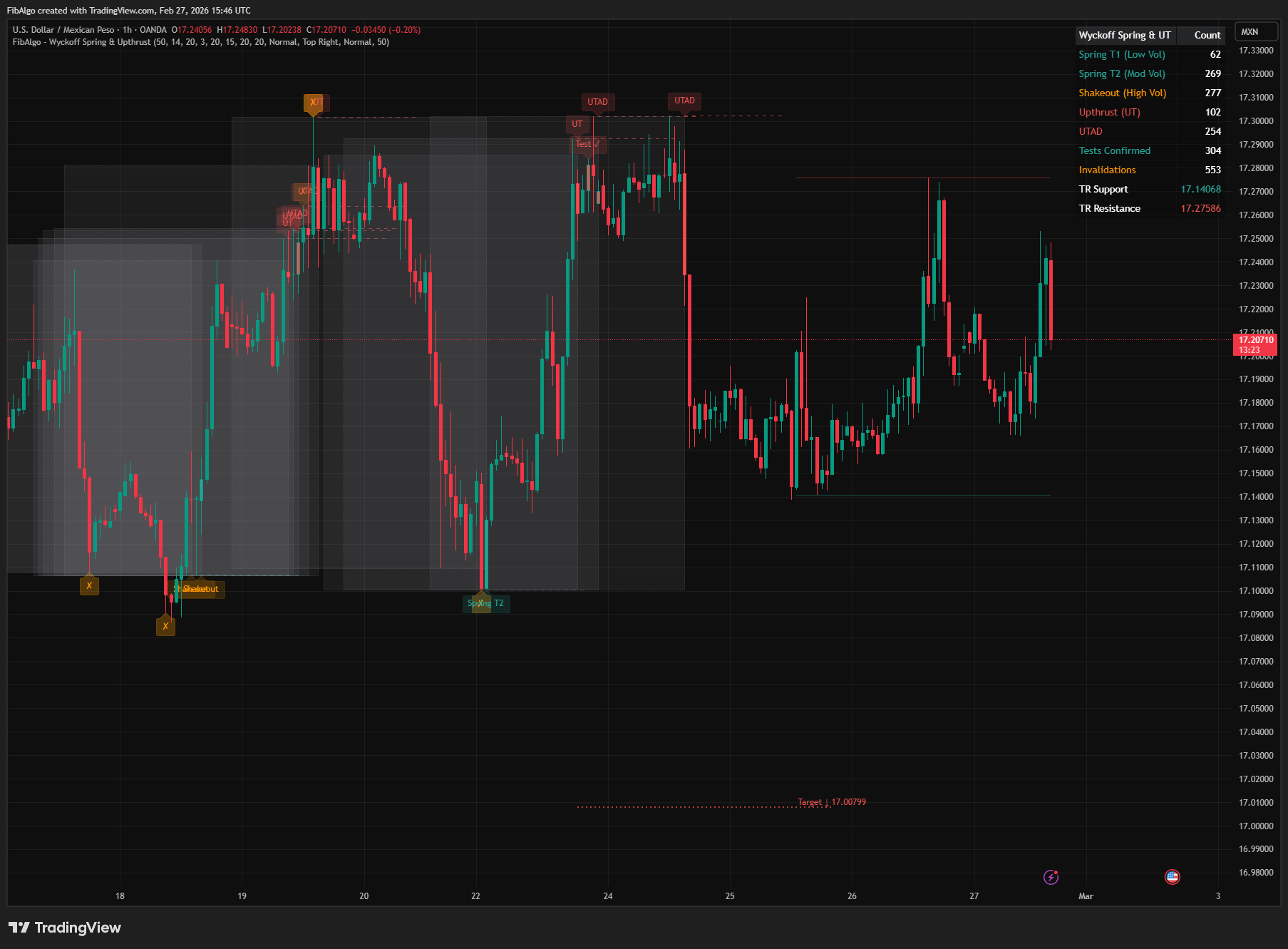
Wyckoff Spring & Upthrust
TradingView indicator that detects Wyckoff Springs and Upthrusts — the two most actionable reversal events with volume classification and price targets.
See Details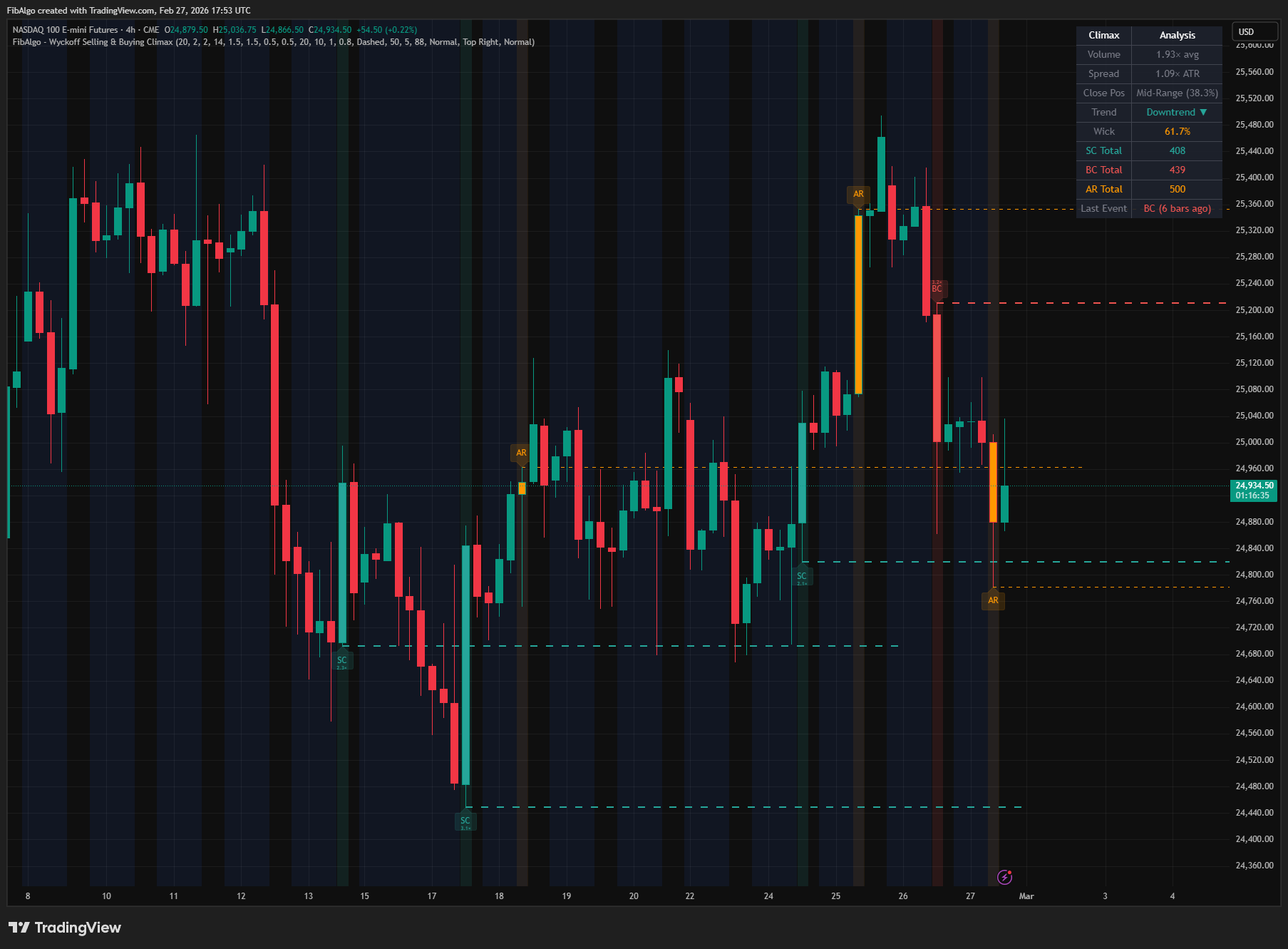
Wyckoff Selling & Buying Climax
TradingView indicator that detects Wyckoff Selling and Buying Climax events — extreme institutional pressure signaling potential trend exhaustion.
See Details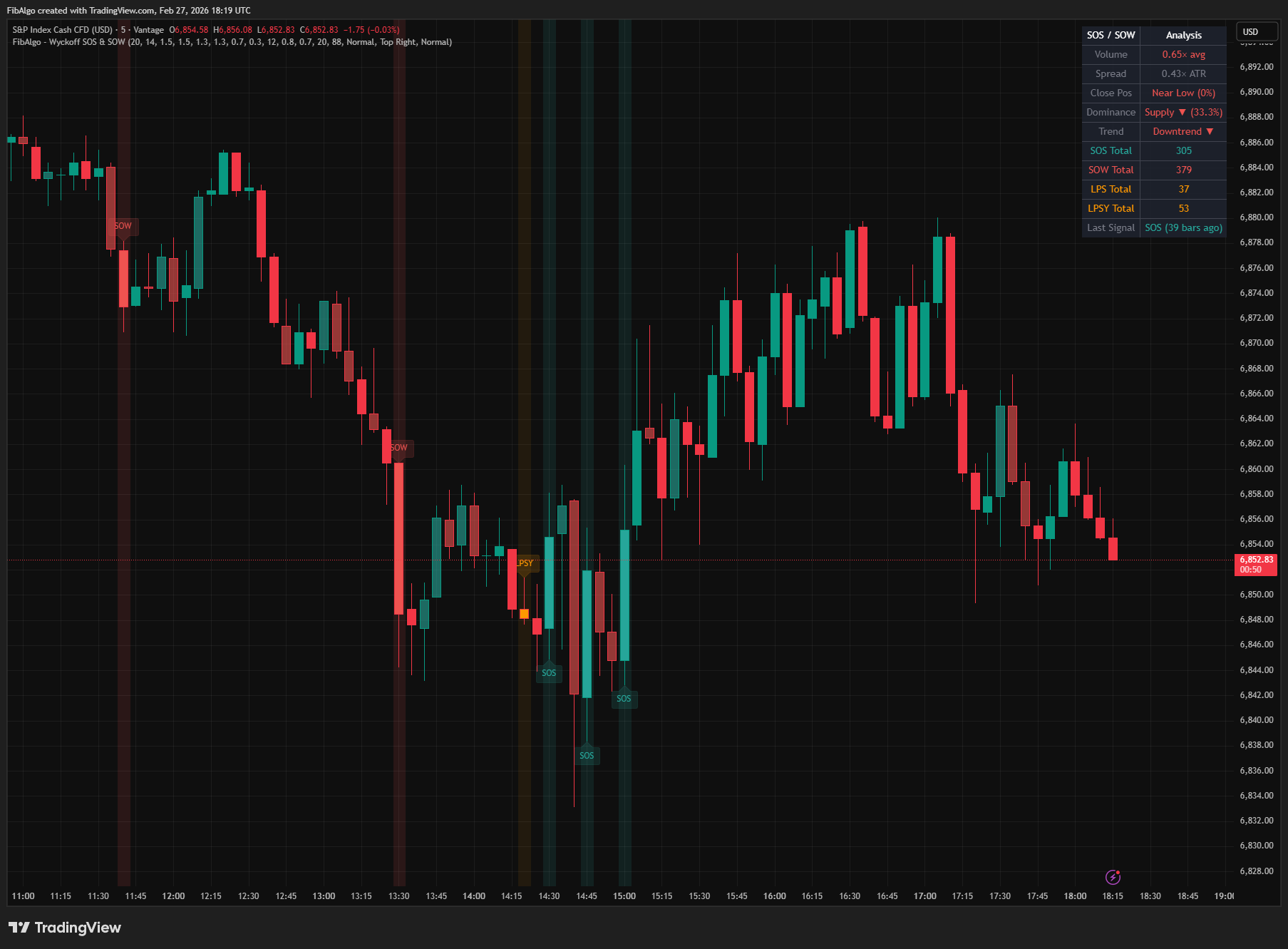
Wyckoff SOS & SOW
TradingView indicator that identifies Wyckoff Sign of Strength (SOS) and Sign of Weakness (SOW) events with LPS/LPSY confirmations.
See Details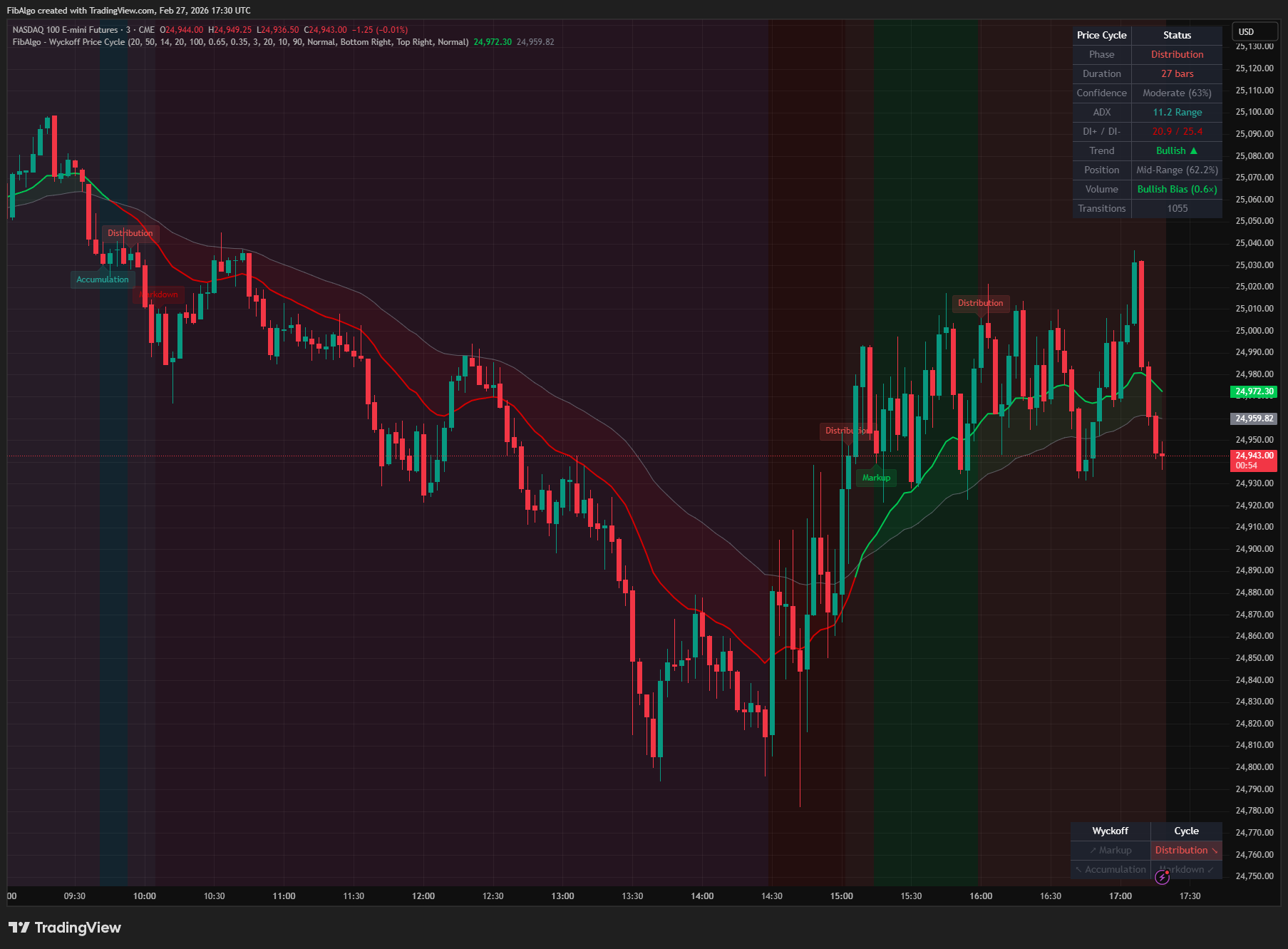
Wyckoff Price Cycle
TradingView indicator that identifies the four Wyckoff market cycle phases — Accumulation, Markup, Distribution, and Markdown — confirmed on closed bars.
See Details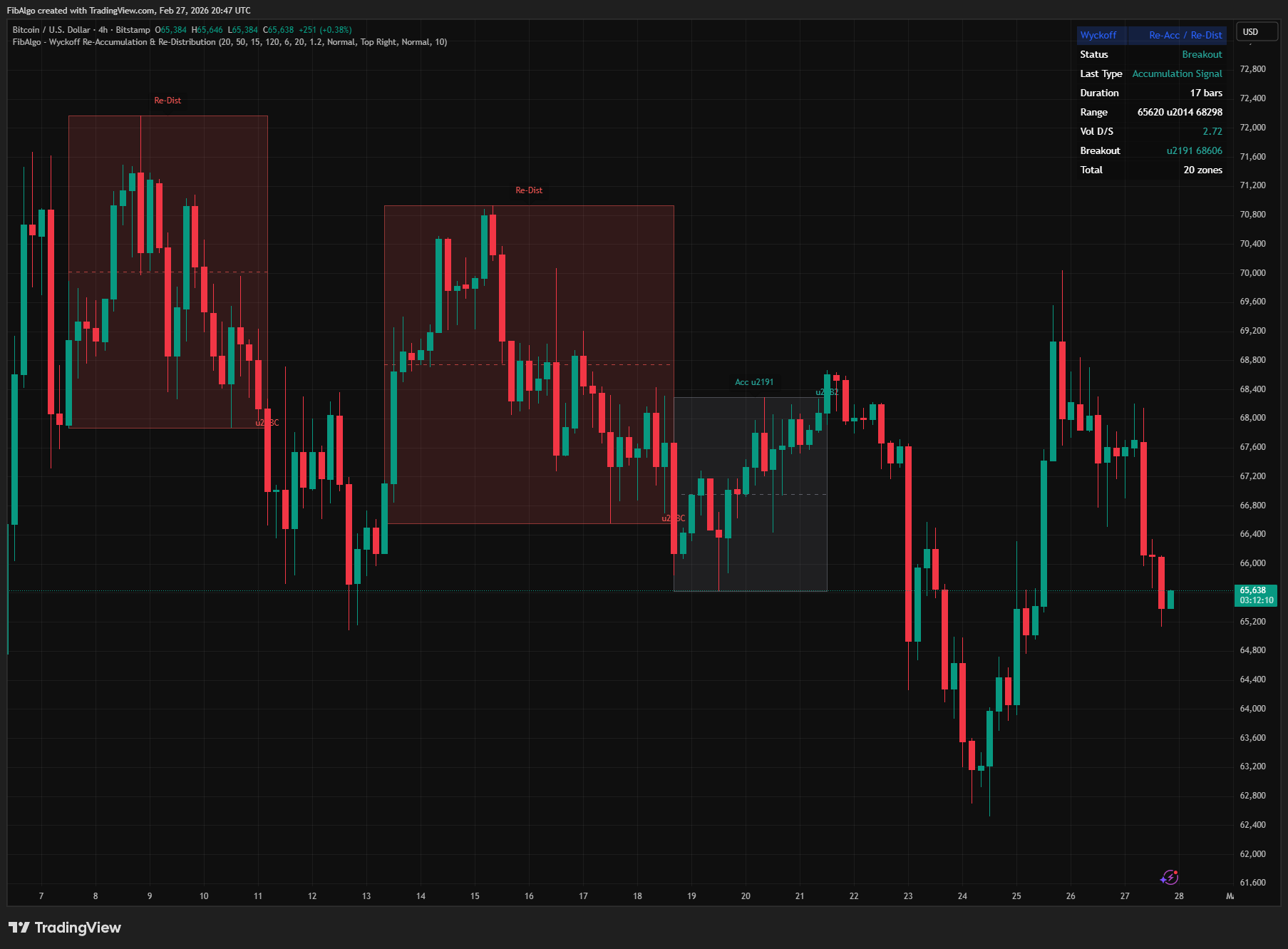
Wyckoff Re-Accumulation & Re-Distribution
TradingView indicator that detects Wyckoff Re-Accumulation and Re-Distribution patterns — consolidation pauses within established market trends.
See Details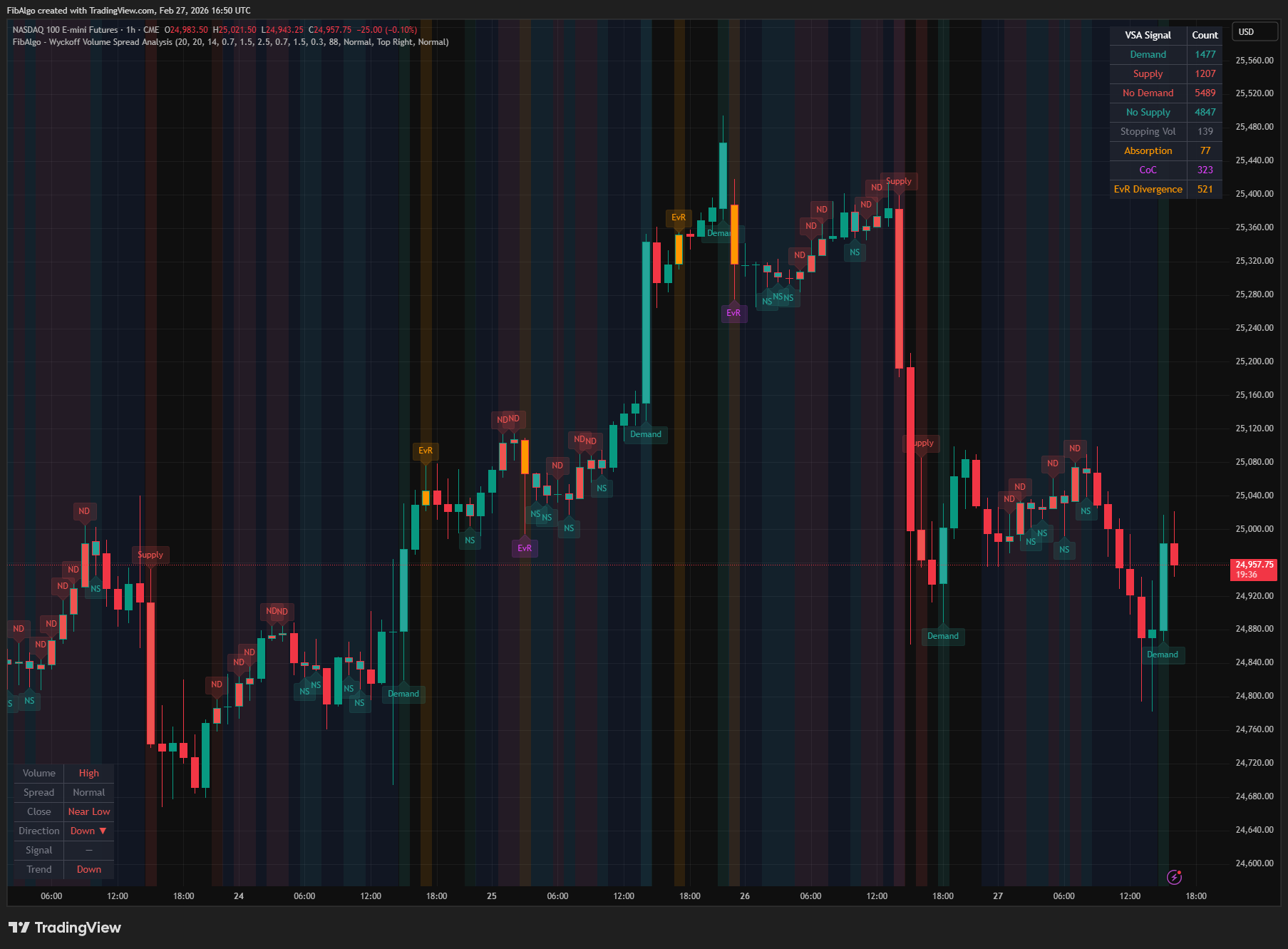
Wyckoff Volume Spread Analysis
TradingView indicator that classifies bars into eight Wyckoff VSA signal types by analyzing volume, spread width, and close position.
See Details